
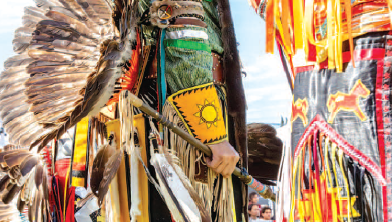
For a day everything that is good about the world came together in the warm air on the cool manicured soccer field of Southwestern College.
The People were back.
So were the reassuring drums, spirited dancers, exquisite jewelry and intoxicating frybread.
And they were happy.
Even as rockets rained down on Iran, hopefulness permeated The People and their guests. It was an outbreak of peace.
“Not everything in the world is happy this morning, but we can be happy right here today,” said Walter Ahhaitty, the philosophical Master of Ceremonies. “We have to remember to be happy because when you are an Indian everything we do is difficult. We sing different, we dance different. Our differences can be difficult, but also things of great beauty.”
Diné People (Navajo) urge others to “walk in beauty,” and Southwestern’s third annual Powwow was a circular promenade of the sublime. Children celebrated elders, elders celebrated descendants and everyone celebrated those who came before.
“When you raise your eyes and see across the beauty of Mother Earth you can see a sunlit path forward,” said Ahhaitty. “It is still there. It is always there.”
‘We Never Left’
Haw Kemyulk, the life-giving Sweetwater River, was flowing again following February rain, reasserting its place as the lifeblood of the region’s Kumeyaay People.
“Sometimes you cannot see the river because it is flowing underground, but Mother Earth has her arms around Haw Kemyulk,” said Barona spiritual leader Bobby Wallace. “Mother Earth has her arms around all of us, even when we are not seen.”
This powwow was a coming together and celebration, said Diné activist Sheilah Naajiibah Green. As a young girl Green spent time living in her grandmother’s hogan in Sanders, Arizona before moving to Chula Vista. She was a Student of Distinction Award recipient at Southwestern and a much-honored scholar at CSU San Marcos.
Green said local powwows are peaceful celebrations but also acts of defiance.
“We are still here,” she said. “No matter what anyone has done or what anyone says, Indigenous people are still here. We never left.”
Native Americans have been intentionally undercounted by the U. S. government since 1790, she said. Census counts have “American Indians” at 1.1 percent of the population. Adding People who identify as Native Alaskan boosts the number to 2.9 percent. Green said she is not buying it.
“The government numbers are very misleading,” she said. “We are way more than 2 percent. Low census numbers keep us politically weak like we are too small to matter. But the question is the problem. The census should ask who identifies as Indigenous to North and South America. That’s a whole different number.”
Green said the census numbers would be at least 30 percent if the census modernized its language.
“For years my mother was counted as White,” said Green. “My mom is full-blooded Diné.”
Ahhaitty agreed. What’s in a name matters, he said.
“When I was growing up we were called American Indians, then later Native Americans,” he said. “Now we are Indigenous. A lot of folks have come up with a lot of names for us. You got to be careful what you let people call you, how they identify you.”
Ahhaitty said he is okay with the term “Indigenous,” but prefers to be known as Kiowa.
“I’m Kiowa tribe of Oklahoma,” he said. “The People here are Kumeyaay. This is Kumeyaay land. Man, I like to say Kumeyaay! It’s kind of like saying Kiowa!”
Warriors For Our Land
Ahhaitty said he also likes to be called a veteran. He served in the U.S. Marine Corps, he said, and is Semper Fi to the American military.
“People ask me why so many Indians serve in the military even though we’ve had a hard time with the U.S. government,” he said. “That’s easy. This is our land and we fight to defend it. We are warriors for our land and our People. Indigenous People are the highest per capita of any Americans serving in the military. We are great soldiers and Marines.”
Powwow leadership was brimming with veterans. Retired Marine Adam Loga greeted every dancer entering the arena. Head Gourd Dancer Mike Diaz is a decorated Navy and Army veteran. Eagle Staff Carrier Richard Decrane served with honor in the U.S. Navy for 15 years. His Navajo name is “The Warrior Who Has Returned to His People.”
As dancers made ready to enter the arena, elder Chuck Cadotte asked for a blessing.
“Godfather,” he prayed, “please bless everyone dancing, drumming and singing today. They are all beautiful just as you made them beautiful,”
Drums thundered to announce the traditional powwow Grand Entrance, a pulsating stream of committed dancers and traditional regalia flowing into the arena as the river Haw Kemyulk pushes through the nearby Sweetwater Valley.
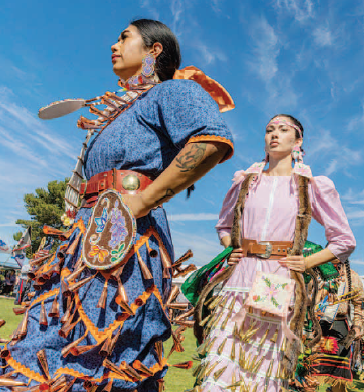
“Hay ya!” hollered Ahhaitty, the traditional Native greeting to convey happiness and gratitude. “A’ho (thank you) drummers and dancers!
Former Miss Teen San Diego and Hollywood film actress Myra Mondregon returned home to carry a flag honoring legendary American Indian Movement leader Dennis Banks, who died in 2017.
“I’m honored to be here,” she said. “My father is Indigenous and I am proud to be an Indigenous person. I grew up in Bonita, so it is great to be able to participate in a powwow at Southwestern College.”
Mondregon has a degree in civil engineering and hopes to use her education and love for the environment to help provide clean water for people around the globe.
“It all fits together,” she said. “Indigenous People are the original stewards of the Earth and its water. We are relearning what they knew.”
Powwows are famously inclusive and have become more prevalent in the wake of the Pan-American Movement which encourages North America’s nearly 1,000 nations, tribes and bands to celebrate together and embrace each other’s customs, music, regalia and spirituality. They are also multigenerational and actively work to develop leadership in children and teens. Head Tiny Tot Girl Alessi Murphy, 3, is a member of the powwow’s Head Staff, along with Head Tiny Tot Boy Jacob Mato Wasaka Fixica.
Returning From The Rocks
In 1987 the renowned anthropologist Dr. Florence Shipek published her seminal book “Pushed Into the Rocks” about the forced relocation of Kumeyaay and Ipay People from the San Diego County coastline into the barren rocky foothills that made survival difficult. Barona spiritual leader Bobby Wallace said his People are pushing back.
“We are trying to incorporate more Native students into Southwestern College and make them feel that this is a place they can call their home,” he said. “We haven’t been out of the bushes for too long. (This is an) opportunity to feel comfortable about getting off the hill and getting an education.”
David Salomon, assistant professor of Native American Studies, has been the energy and academic heft of a new movement at Southwestern College to recognize and celebrate the Indigenous People of San Diego County. Its powwows have provided fuel.
“We want to see it go on (and reach) our 10th annual and our 30th annual,” he said. “We’d like to continue a tradition here on campus because it opens doors for all of our Native People. It’s about opening doors and letting them know, ‘Hey, Southwestern College cares about the Native community.’ And that’s our huge goal here.”
Invitations
Photographer Ines Cervantes got a taste of powwow kindness as she crawled around on her stomach to get the low angle shots that make Native dancers look well framed and flattering.
“Everyone was so nice,” she said. “I was laying on the ground for photos and everyone was really nice about it. One of the performers saw that I looked red (from the 93-degree heat) and gave me a little coffee bean candy to chew on.”
Whether the bean had magical properties or the spirit of kindness was kindled inside her, Cervantes said the candy instantly made her feel better. Taking photos at the powwow was inspiring and enjoyable, she said.
“I really loved the designs and colors of the (regalia),” she said. “The singing was beautiful and it seemed to make people so happy. It was great to see so many people so deeply engaged in their culture. It’s truly beautiful.”
Diné activist Green has two sons who are competitive dancers and young Native American scholars.
“I am thankful for this powwow because it brings my boys and other Indian children to a college campus,” she said. “It makes them aware that college is out there for them in the future.”
A full moon hung as a single luminescent pearl in the gradient colors of the evening sky. Sheilah Naajiibah (Woman Who Went to War Many Times) reveled in the peaceful beauty of the sunset and the satisfaction that her boys had danced well and had fun.
“When I was a student here there was nothing remotely Native American,” she said. “I was alone. It is amazing how Southwestern College has changed. People here see us now. We’ve been invited back.”

Angel Gonzalez, Madelyn Batuyong, Arianna Antillon, Ines Cervantes and Joshua Whitehead contributed to this article.


