
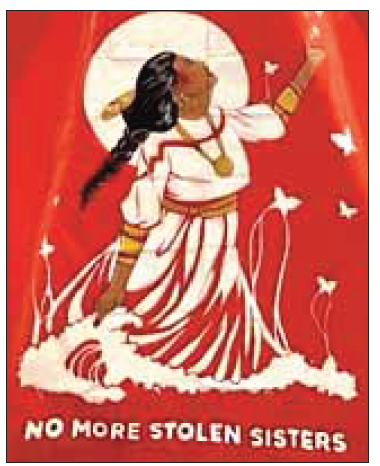
Teyana Viscarra was holding forth and holding space when she suddenly started to cry.
Sometimes even a fierce warrior has to shed tears.
“It can be a lot to think about,” she said. “I still have trouble getting around the enormity of it.”
Viscarra is an energetic advocate for the tens of thousands of Native American women and girls missing and presumed murdered. It is America’s most deadly epidemic of violence and its least known, she said. Government and law enforcement fail to count the vast majority of the disappeared. Record keeping has been negligent, but the estimates are shocking. It is likely that as many as 10,000 Indigenous women and girls are kidnapped, sexually assaulted and murdered every year.
Viscarra said too few tears are shed for “our beautiful and vulnerable sisters.”
“Indigenous women can disappear without a trace and then days and weeks go by before they are reported missing,” she said. “Thousands just fall through the cracks. Many live on remote reservations where tribal police are overmatched. City and county law enforcement do not consider these women to be under their jurisdictions. They go unreported and uninvestigated. The FBI rarely gets involved.”
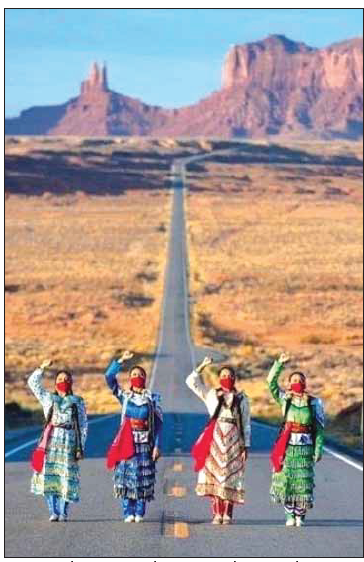
Advocates with the Urban Indian Health Institute say Missing and Murdered Indigenous Women and Girls disappear three times – in life, in the news media and in the data. Numbers are all over the place. Notoriously, in 2016 there were 5,712 cases of missing Indigenous women reported in the U.S. The Department of Justice logged only 116.
Efforts by Biden Administration Secretary of the Interior Deb Haaland – the only Native American to ever hold the position – to improve coordination between federal law enforcement, state agencies and tribal police were dismantled by the Trump Administration.
“We are pretty much flying blind,” said Norm Sands, who along with Viscarra heads the Chula Vista-based Native American advocacy organization Way of the Sacred Mountain.
Sands, Viscarra and supporters created the Red Tipi, a visual representation of the crisis. A full-sized replica of a Plains Indian tipi, the bright crimson color is to attract spirits. White handprints represent the missing. Some of the hands on the tipi are prints by family of kidnapped and murdered women or girls.
Like the AIDS Quilt, the Red Tipi is a public exhibit inscribed with private messages including, “Breezy, you are loved. You did not deserve this.”
Viscarra said the tipi is a healing prayer as well as a call to action.
“We travel with the Red Tipi to hold space and educate,” she said. “Most people don’t know anything about missing and murdered women. I think people would want to help do something if they knew the situation.”
Way of the Sacred Mountain volunteers post up the Red Tipi at powwows like Southwestern’s, public events, in front of police stations and on mountaintops. Holding space is not easy, Viscarra said.
“Sometimes we have hundreds of people join us on prayer runs or events, sometimes it’s just Norm and me,” she said. “It does not matter the size of the crowd. The important thing is to hold the space and remember our sisters.”
Powwow Master of Ceremonies Walter Ahhaitty and Barona spiritual leader Bobby Wallace offered prayers for Missing and Murdered Indigenous Women and Girls from the dance arena. Cherokee activist Nico Johnson was one of the many who spoke up for the missing.
“Women like Teyana who fight violence against women are warriors,” he said. “It is a cause that needs lots more attention from the good people in our country.”
The Great Kumeyaay Nation unites with the Great Law of Peace to fortify and promote the growing world-wide cultural movement to reclaim indigenous languages as the cultural connection unifying tribal nations.


