
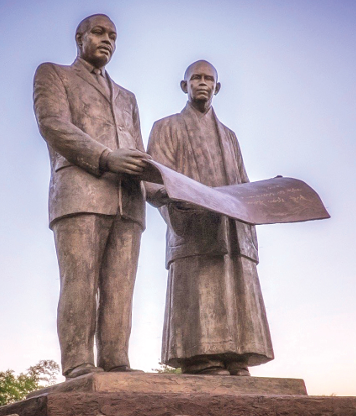
Photo: Statues of Dr Martin Luther King and Buddhist teacher Thich Nhat Hanh
In 1966, two towering moral leaders—Thich Nhat Hanh and Martin Luther King Jr.—met at a moment when the world was trembling under the weight of war, racism, and moral reckoning. Their meeting was brief in time but vast in consequence, forging a spiritual and political kinship that would deepen Dr. King’s commitment to nonviolence and global peace.
Thich Nhat Hanh, a Vietnamese Zen Buddhist monk and peace activist, had come to the United States to call attention to the
devastating human toll of the Vietnam War. He spoke not as a
partisan, but as a witness—one who had seen villages burned, families torn apart, and suffering normalized by geopolitics.
When he met Dr. King, the two recognized something profound in each
other: a shared belief that nonviolence was not merely a tactic, but a way of life rooted in compassion, courage, and moral clarity.
Thich Nhat Hanh later reflected on Dr. King with deep reverence, writing, “I saw Martin Luther King not just as a leader of the civil rights movement, but as a great bodhisattva, a being of compassion and wisdom.”
This was no casual praise. In Buddhist tradition, a bodhisattva is one who dedicates their life to relieving the suffering of others—an apt description of King’s spiritual approach to justice.
For Dr. King, the meeting was transformative. Until then, he had been
cautious about publicly opposing the Vietnam War, concerned about political backlash and the potential dilution of the
civil rights movement. But Thich Nhat Hanh’s firsthand testimony helped
crystallize what King already felt in his conscience: that silence in the face of mass suffering was itself a form of violence. Shortly after their meeting, King delivered his historic 1967 speech, “Beyond Vietnam: A Time to Break Silence,” declaring, “Injustice anywhere is a threat to justice everywhere,” and naming the United States as “the greatest purveyor of violence in
the world today.” That same year, Dr. King nominated Thich
Nhat Hanh for the Nobel Peace Prize, calling him “an apostle of peace and
nonviolence” and praising his extraordinary efforts to awaken the world
to the human cost of war. Though Thich Nhat Hanh did not receive the prize, the nomination symbolized something far greater: a bridge between East and West, Buddhism and Christianity, the Black freedom struggle and the global peace movement.
The meeting of Thich Nhat Hanh and Martin Luther King Jr. reminds us that
movements for justice are strongest when they are rooted in spiritual integrity and global compassion. Together, these two giants showed the world that true nonviolence demands not only resistance to oppression, but a radical love for humanity itself.
Their legacy continues to call us—across faiths, cultures, and generations—to walk the difficult but
necessary path of peace.



