
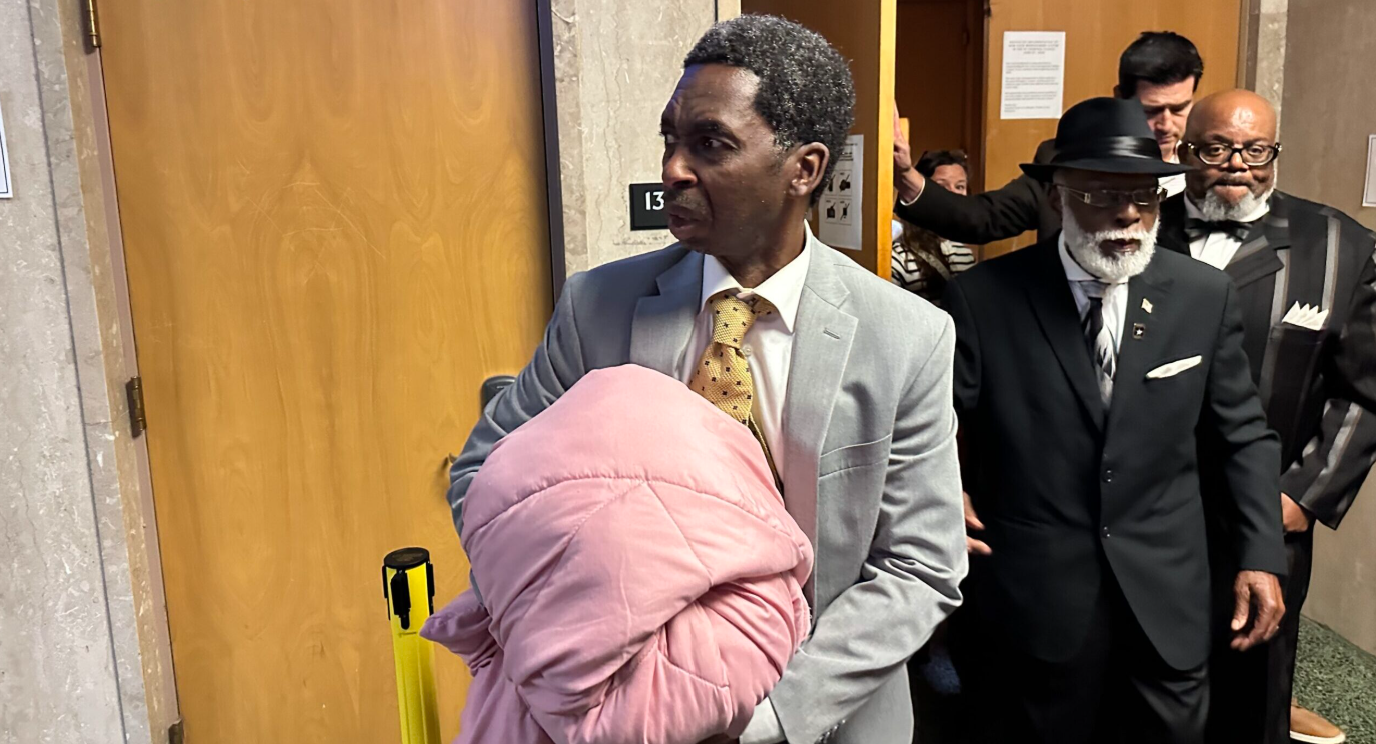
Kevin Epps — an award-winning director and executive editor for the San Francisco Bay View — was sentenced April 8 to six years and eight months in state prison for the 2016 murder of Marcus Polk. Epps holds his daughter's blanket in San Francisco Superior Court; to his right is Rev. Dr. Amos Brown. (Credit: Eric Arnold)
Sustained outpouring of community support — a defining aspect of Kevin Epps’s murder trial — ultimately fell short at his sentencing hearing.
On Wednesday, April 8, Judge Brian Ferrall sentenced Epps to six years and eight months in state prison, dashing the hopes of supporters that he might receive probation or the minimum sentence of three years.
Last December, Epps, a San Francisco-based filmmaker and award-winning journalist, was acquitted of first-degree murder charges but convicted of voluntary manslaughter in the 2016 shooting of Marcus Polk. Throughout the trial, his supporters held numerous rallies and press conferences outside the courtroom steps, promoting a narrative that Epps had been wrongfully charged and convicted.
In his ruling, Ferrall emphasized that the deciding factor was that Epps, who had four prior felony convictions, was in illegal possession of a firearm. Had Epps not illegally possessed a gun, Ferrall said, “we would not be here.”
California law stipulates harsher penalties for convicted felons who use a gun to commit violent crimes.
That meant probation with no jail time was never a viable option, leaving the judge to impose a sentence of three, six or eleven years. Ferrall rejected prosecution arguments for stiffer penalties that could have doubled the sentence and added additional years under the “three-strikes” law. But he also said the jury had already considered mitigating factors in acquitting Epps of first-degree murder.
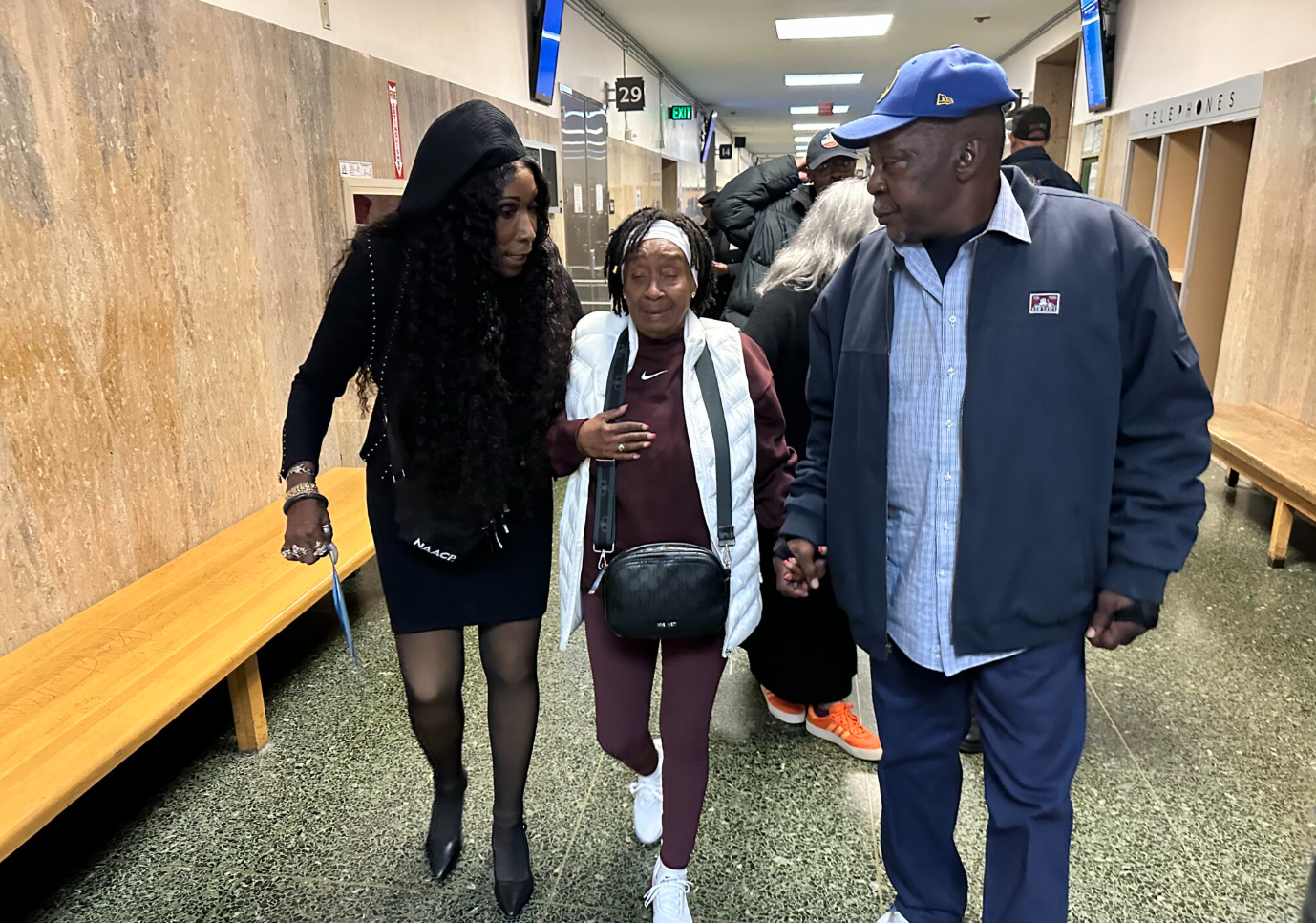
The pronouncement of the sentence sent a palpable chill through the courtroom, where Epps’ friends, family members and African American faith leaders had gathered in a show of support. As it became clear that Epps would be remanded into custody, his daughter Tyler and mother Brenda rushed out of the room in tears. Brenda Epps was later seen clutching her asthma inhaler as if it were a sacred rosary.
The sentencing culminated a dramatic and emotionally charged courtroom session that began with both sides’ attempts to influence the judge’s decision.
Marcus Polk’s family, represented by daughter Melina Polk and stepchildren Jalea Hale and Sean Hale, argued for the maximum penalty, raising allegations of a pattern of domestic violence, verbal abuse and controlling behavior by Epps. Marcus Polk’s death, they said, had left them traumatized, with post-traumatic stress disorder and depression. Jalea Hale lamented that Polk “would never get to see his grandchildren.”
Epps’ supporters painted a completely different picture: a dedicated father who was always there to uplift the community. Dr. Kim Williams traveled from Virginia to recount Epps’ role in community health outreach during the pandemic. The Rev. Aloysius Walker remarked on how effective Epps had been at finding solutions for inner-city problems in his Hunters Point neighborhood. And Epps’ 12-year-old son Kamia said “he comes to all my games and never forgets to bring me water.”
Epps, who did not testify during his trial, took the stand at sentencing to express regret and remorse. He said he felt “deep sorrow and humility” and took full responsibility for his actions, adding that he prays for Mr. Polk’s family and asks for forgiveness “every day of my life.”
The judge, however, did not grant forgiveness, instead noting that Marcus Polk represented the “least empowered in our society — a person on parole, addicted to drugs, unhoused, unemployed, no real resources and armed with a remote control at the moment of death.”
The sentencing capped a legal process with numerous twists and turns over almost a decade. An initial finding of insufficient evidence became a first-degree murder warrant three years later, based on purported new evidence that was later withdrawn. Initially denied bail, Epps remained free after community members sent hundreds of letters to the court on his behalf. Six years later, when the case finally went to trial, Polk’s family significantly changed their recollections, adding new details that supported the prosecution’s theory of the crime.
The question of whether Epps was “a felon with a gun,” as the prosecution contended, or a committed activist and community asset, as defense lawyers and supporters maintained, became central as the trial played out. In explaining his decision, Ferrall indicated both could be true and that community service does not erase the seriousness of violent crimes in the eyes of the court.
“I know you will do good for the community when you get out,” Ferrall told Epps.
Concerns about the fairness of the proceedings lingered among Epps’ supporters, who issued a statement saying the sentence “marks a profound failure of justice — one that compounds nearly a decade of prosecutorial overreach, distortion of evidence, and violations of fair trial rights.”
Calling the trial a “case study in an enduring systemic problem,” supporters noted that Epps will appeal the verdict and the sentence. A bail hearing pending the appeal has been set for April 20.
(This article originally appeared in American Community Media under the title "Despite Community Concerns, Epps Sentenced to Prison Time")


