
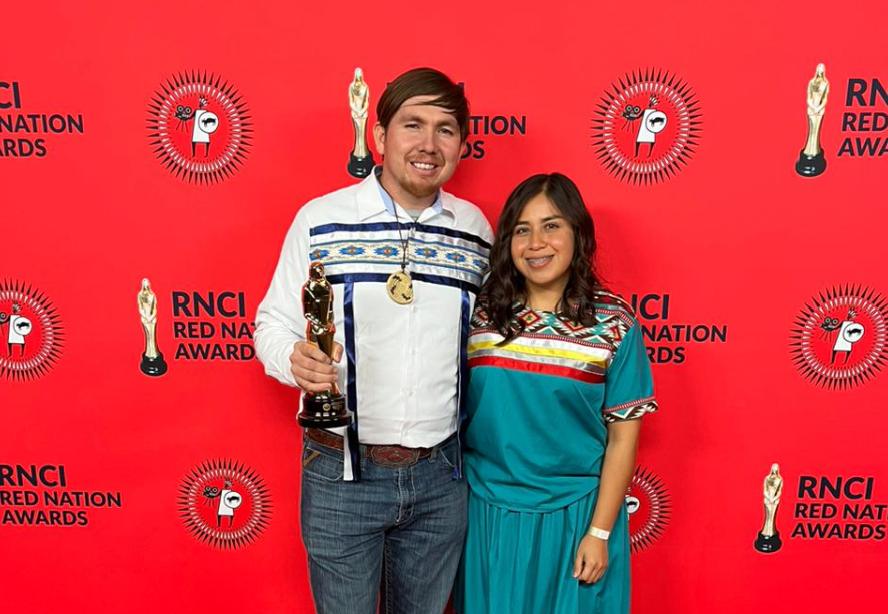
Photo: Dylan Verrechia, Director wins Red Nation Film Award of Excellence for Best Documentary "Kumeyaay Land" Dylan Verrechia Films Red Nation Film Festival 2024-11-17, by Yoniemora, Wikimedia
Spiritual Warriors roam the mountains of San Diego silently protecting the ancestral land and the tribal occupants who have called the sacred Kumeyaay soil home for millennia. The culture and tradition has been preserved and protected by unseen forces to provide a cultural shield against modern day colonization. Preserving language is the highest priority. Long before Indigenous Intelligence gave rise to Silicon Valley unleashing the Age of Information, giving rise to a technological industry that sends shock waves through the cerebral cortex of human kind. Linguist and cultural preservationists were alert to the vulnerability of Indigenous language as it is the key to cultural control and social order. Predictably, tech oligarchs are lined up with spreadsheets in hand, like a modern day General Custer waiting for the appropriate moment to exercise power against tribal people.
The first kind of defense for indigenous and tribal communities is tradition. Kumeyaay oral tradition defines the community’s cultural identity.
Forms of oral tradition such as narrative and song often serve as important cultural resources which retain and reinforce cultural values and group identity. This is particularly true of the Kumeyaay community of Baja California Norte, Mexico. Such stories are an important form of cultural property which group identity - Oral traditions form an important body of knowledge that not only preserves cultural values and philosophical orientations, but also continues to imbue these values in its listeners. American Indian communities typically view their oral traditions as communal intellectual property.
The Kumeyaay Community of Baja California
Kumeyaay is the indigenous language of the San Diego area as well as the northernmost part of Baja California Norte, Mexico, extending southward from the US/Mexico border for about 50 miles. Today, Kumeyaay (specifically, the Tiipay dialect of Kumeyaay) is still actively spoken by about 50 speakers who reside in Mexico, but is very close to obsolescence north of the border. The Tiipay community extends from about 50 miles east of San Diego to the coast, encompassing 13 distinct communities, each with its own slightly different variety of spoken Tiipay. Just north of these Tiipay communities are the related ‘Iipay’ Kumeyaay communities, which share many similar cultural values, but whose dialects are very different.
In all of the Kumeyaay community as well as most of Southern California, singers are important repositories of traditional oral literature, as stories are typically not only told but also embodied in song cycles. In the San Diego area, the most well- known of these song cycles are “bird songs,” which tell the story of early migrations of Yuman people from the Colorado river area throughout southern Alta California, Baja California, and adjacent Arizona. Other Southern California song cycles include Lightning songs and Wildcat songs, among others. One of the authors of this article, Jon Meza Cuero, was the sole teacher of the Wildcat singing tradition, and a member of the Baja Kumeyaay (Tiipay) community.
In today's social culture of unrest it is psychically soothing to breathe the air that has filtered through Kumeyaay land as it flows down the mountain to San Diego. It is good medicine and communication at the highest frequency allowed by the Ancestors.
An awakening of collective consciousness is gradually taking place among those concerned and actively involved in lending energy toward positive change. Civic and bureaucratic institutions are becoming more culturally aware and sensitive.
The role of the media could not be more critical. The relationship of the evolving media and the Indigenous culture media in tribal land, and the importance of protecting and preserving the connection to the unique and important connectivity to the Ancestors, as the fragile relationship of the contemporary corporate landscape threatens this delicate relationship. The human need to bond and communicate is infectious.
Southwestern College in Chula Vista CA is squarely in Kumeyaay land
Max Branscomb, Ed.D., Professor of Journalism and Adviser for Student Publications points out that there has been a notable rise in interest in Native American academic inquiry and participation. Traditional Kumeyaay ceremonies have been performed on campus by traditional performers from the local reservation and attended by interested students.
Respected Kumeyaay elders and educators Hank and Shirley Murphy, long time advocates of historic preservation and tradition, are essential to the importance of information sharing and the importance of the media in communicating to the world the significant role that the tribal community plays in creating a healthy balance and moral clarity of the outside world.
The legacy corporate news media struggles with an identity crisis as it takes the world center stage. It is polluted with contemporary lust for economic rewards combined with absence of authenticity within the confines of a reality show.
In the meantime, a newly minted eager and creative army of writers and photographers are eagerly filling a void and satisfying a public hunger for information while developing an indigenous independent media movement.
Independent Media Movement in collaboration with Dr. Margaret Fields


