
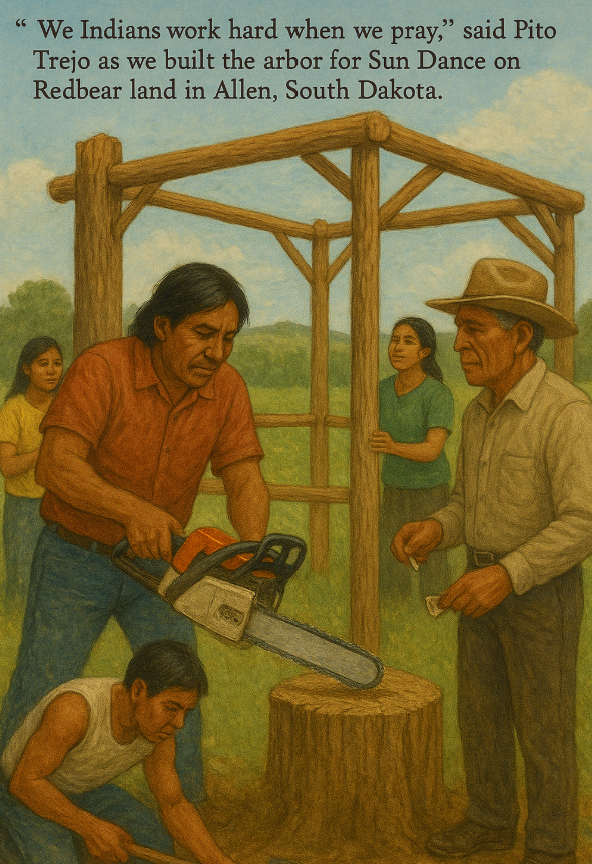
“We Indians work hard when we pray,” said Pito Trejo as we built the arbor for Sun Dance on Redbear land (his mother’s people) in Allen, South Dakota.
I had never thought of prayer as work, but work I did with the Trejo family and other invited guests. I even helped dig a new hole for an outhouse, or whatever else was needed
Pito’s father, Lupe (Pito was short for Lupito of “Little Lupe”) was cutting pine trees for poles for the arbor. He needed only a few pines with 6-inch or so diameter for the purpose, and after he instructed me how to use the chain saw, he broke open a pack of cigarettes and placed the tobacco on the stump.
The tobacco was Lupe’s gesture of thanks.
I worked as fire keeper for that Sun Dance. For days after I left Pine Ridge, I was on a spiritual high. I arrived home at noon after a 30-hour drive got a summer job within an hour.
Family friends invited my wife, daughter and I up to Boston for the weekend, only a day later. Blessings were happening so fast.
I wanted that spiritual high again. Years later, in the middle of a troubled second marriage and wondering if my very existence had any purpose in the universe, I reached deep into the Christian faith to which I now belonged.
I read the Bible daily, and prayed just as much. I carried a small pocket Bible and copied down Proverbs onto post-it notes, and stuck them around the screen of my desk computer.
I did this intently and intensely for a couple of weeks, and then I got that high again, that same high I got after Sun Dance.
“We Indians work hard when we pray.” Pito’s words came back to me. The words he said on the edge of the South Dakota Badlands were working on the offices and streets of New York City.
I later joined a Baptist church that held 24-hour prayer sessions and my prior Sun Dance experience prepared me for this work in the pews in the Bronx.
Prayer is joyful work.
You can read more about the Redbear-Trejo family in the autobiographical book, “Lakota Woman,” by Melda Walks Along the Edge Redbear-Trejo


