

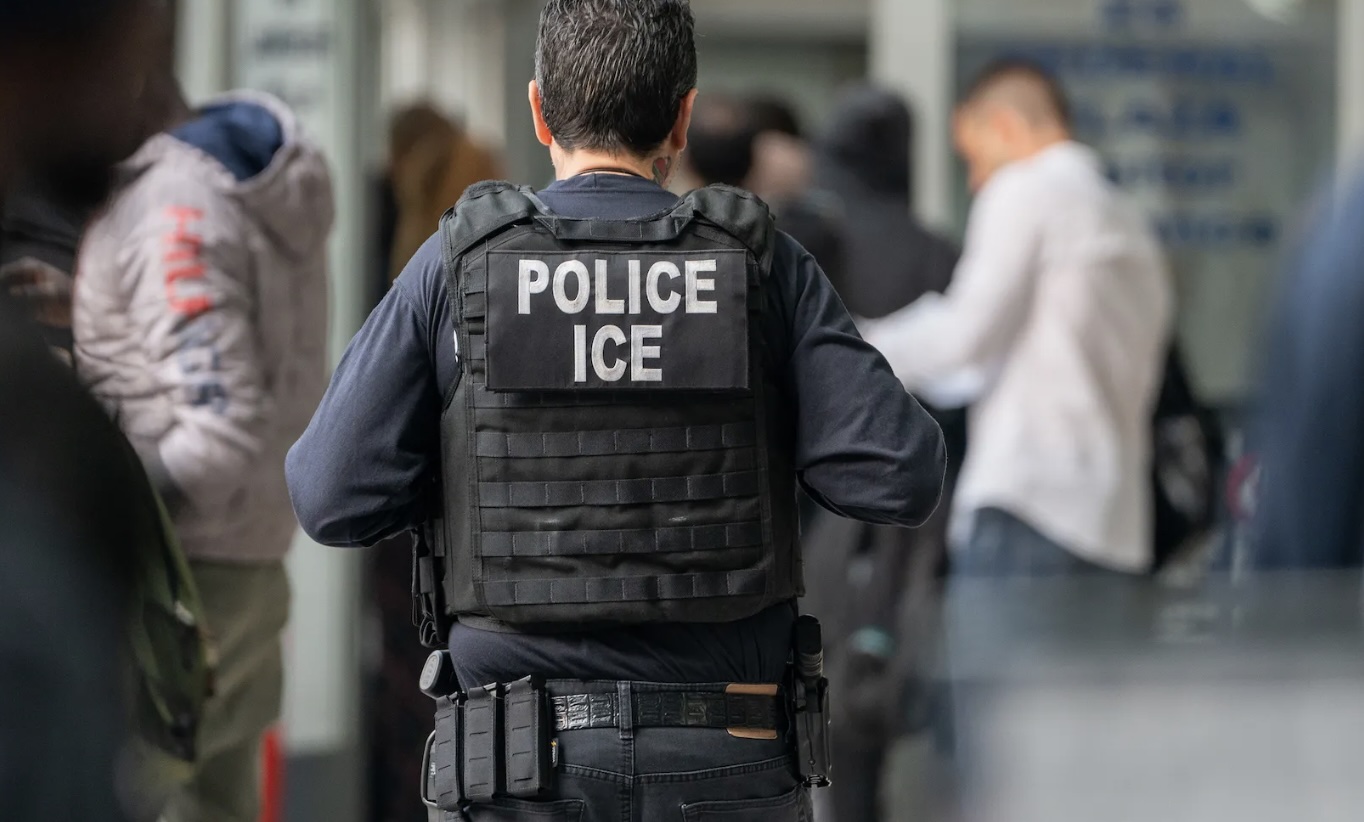
IndigenousNetwork was able to attend a recent briefing hosted by American Community Media examining the growing relationship between local law enforcement and federal immigration enforcement, and the increasingly difficult task journalists face when attempting to uncover how those systems operate together. The briefing focused less on ideology and more on infrastructure: records requests, surveillance systems, detention contracts, public databases, body camera footage, and the bureaucratic mechanics that allow immigration enforcement to expand quietly through local institutions.
At a moment when immigration raids, detention expansion, and ICE operations are again accelerating nationally, the discussion centered on a problem many reporters are already confronting. Much of this activity remains difficult to document in real time. Records are delayed, withheld, or heavily redacted. Agencies deny cooperation publicly while maintaining overlapping operational relationships behind the scenes. And increasingly, the burden of uncovering those systems has shifted onto local reporters, volunteers, legal advocates, and community networks.
Pilar Marrero, associate editor at American Community Media, opened the briefing by noting that “local police departments and sheriff’s offices are playing a growing role in immigration enforcement,” while “records are often incomplete, delayed, or withheld.” The briefing itself functioned partly as a training session for journalists navigating those barriers.
One of the first speakers was David Loy, legal director of the First Amendment Coalition, a California nonprofit focused on transparency and public access laws. Loy discussed a recent lawsuit against the Ventura County Sheriff’s Office involving a large immigration raid at Glass House Farms in Ventura County, where one farm worker died and hundreds were arrested. Community organizers sought body camera footage and records explaining why local deputies were present during the operation. The sheriff’s office initially denied the request, arguing the records were exempt because they involved law enforcement investigations.
Loy challenged that interpretation directly. “Not everything that police or deputy sheriffs do is investigating an alleged crime,” he said. The county ultimately settled and released roughly ten hours of footage.
Throughout the briefing, speakers repeatedly returned to transparency not as an abstract principle, but as one of the only mechanisms communities have to understand what enforcement agencies are actually doing. “Transparency is the oxygen of accountability,” Loy said. He emphasized that law enforcement agencies possess extraordinary authority through detention, force, and surveillance, making public access especially critical.
The discussion then shifted toward practical reporting strategies with Thadeus Greenson, a former journalist now working as press education specialist at the First Amendment Coalition. Greenson described how immigration reporting increasingly relies on local public records rather than federal FOIA requests, which have slowed dramatically in recent years.
Greenson outlined multiple categories of records that reporters can pursue through state public records laws: contracts between detention centers and counties, emergency call logs, internal communications, body camera footage, and automated license plate reader data. He pointed to recent reporting that uncovered agreements allowing private detention facility wardens to determine whether allegations of sexual assault inside facilities would be investigated by local police.
He also described how local 911 call logs have become an unexpected source of immigration reporting, helping journalists document enforcement operations and conditions inside detention facilities. “There’s been some great reporting,” Greenson said, describing investigations built from those records.
One of the more revealing sections of the briefing focused on community rapid response networks, volunteer groups that monitor ICE activity in neighborhoods and communicate raids to residents in real time. These groups have increasingly become key sources for journalists attempting to identify who has been detained during enforcement operations.
Greenson acknowledged both their importance and the strain they operate under. “These organizations are almost entirely volunteer-driven,” he said. “They are overworked and often overwhelmed.” He added that many organizers remain distrustful of media coverage after years of extractive reporting practices, making relationship-building essential for journalists working in immigrant communities.
The briefing also examined the mechanics of public records requests themselves. Elizabeth Clemons from MuckRock provided a detailed overview of how reporters can navigate FOIA and state-level records laws. Clemons repeatedly stressed specificity and patience, explaining that vague “any and all records” requests often slow the process down dramatically.
At several points, Clemons acknowledged that the current administration has significantly slowed response times for federal records requests. “It’s different and slower,” she said. She attributed much of the slowdown to staffing cuts and overwhelmed FOIA departments rather than outright refusal.
The briefing’s final speaker, Austin Kocher, an immigration researcher affiliated with Syracuse University and American University, widened the lens considerably. Kocher has spent years studying how local detention systems, jails, and police agencies feed into federal immigration enforcement. His central argument was that immigration enforcement cannot be understood as a single agency issue.
“All immigration enforcement is local,” Kocher said.
Kocher pushed back against the common misconception that programs like 287(g) agreements are the sole mechanism connecting local police to ICE. In reality, he argued, the system operates through a much broader network of detainers, jail transfers, local arrests, information sharing, and administrative cooperation.
“Federal local collaboration goes back to the late 1800s,” Kocher explained. He referenced the mass repatriation campaigns targeting Mexican communities during the early twentieth century, many of which relied heavily on sheriffs and local police rather than federal agents alone.
At the same time, Kocher acknowledged that current cooperation has expanded rapidly under the present administration. He noted that more than 1,500 active 287(g) agreements now exist across the country, particularly concentrated in Texas, Florida, Georgia, and the broader South. But he also warned reporters not to mistake symbolic political agreements for actual operational changes, since some jurisdictions adopt these programs more for political signaling than enforcement capacity.
One of Kocher’s most important observations was geographic. Immigration enforcement, he argued, operates differently depending on where someone is arrested, detained, or processed. Access to legal counsel, local jail policies, regional courts, and county-level cooperation all shape outcomes in ways that are often invisible nationally.
For Indigenous communities, migrant communities, and rural communities alike, much of the discussion felt connected to broader concerns already shaping public life: expanding surveillance infrastructure, weakened public transparency, and the growing overlap between local governance and federal enforcement priorities. Many of the tools discussed during the briefing, from license plate readers to detention contracts, are systems that increasingly extend beyond immigration enforcement alone.
Near the end of the discussion, speakers repeatedly encouraged reporters not to stop pursuing records even when agencies delay responses or refuse cooperation outright. “Just never give up,” Loy said.
The briefing ultimately painted a picture not simply of immigration enforcement, but of a sprawling administrative system that often operates through paperwork, contracts, databases, and local cooperation long before it appears publicly as a raid or headline. And increasingly, understanding that system depends on reporters willing to spend months pushing agencies for records that governments often hope nobody asks to see.


