
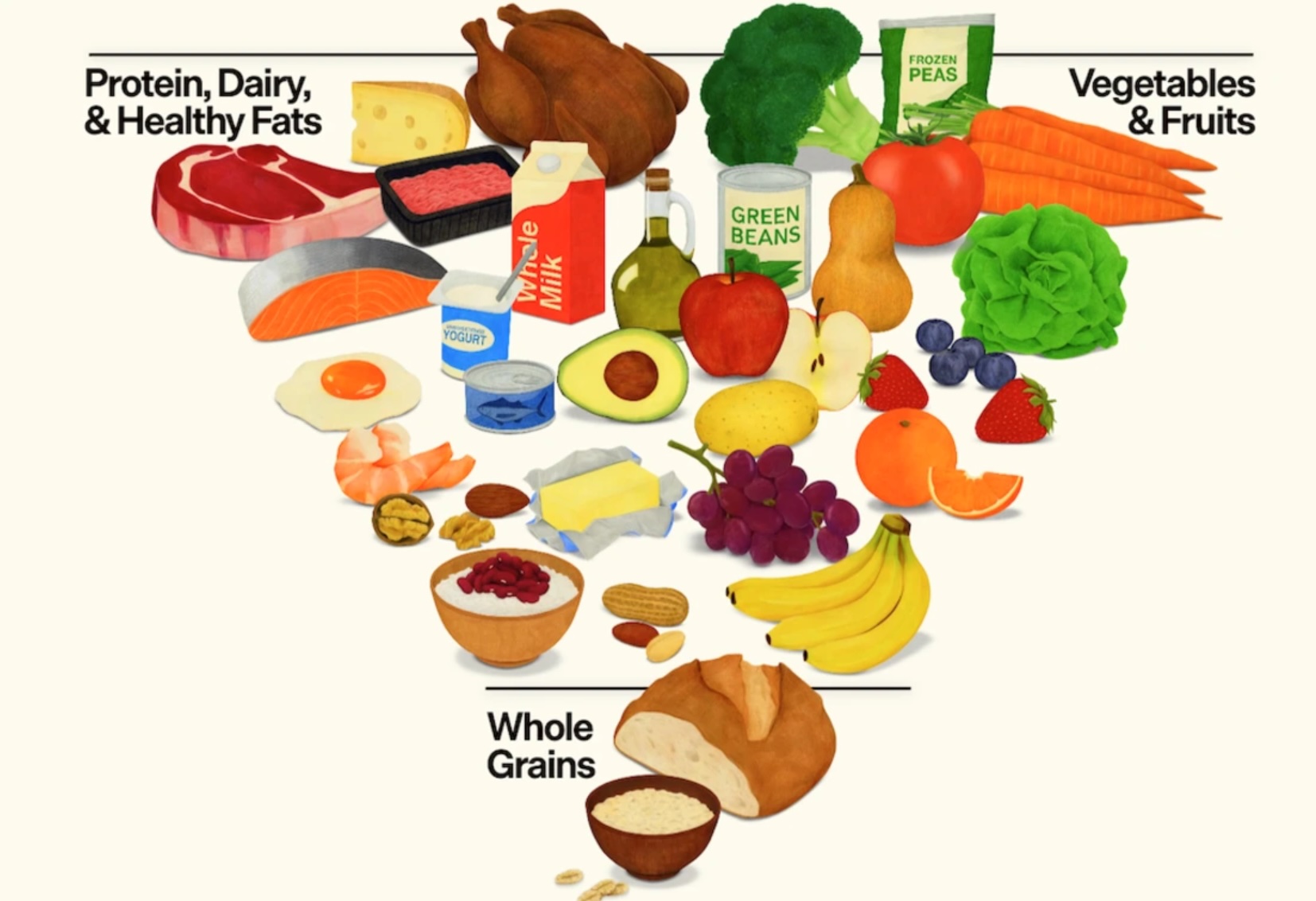
What a time to be alive. Everything in the world is changing - even the foods we eat.
At this news briefing from American Community Media, we journalists spoke about the new federal food pyramid. But what it means is so much more than nutrition. Its also a signal of where the country is heading on health, industry, and control.
It was one of those briefings that starts simple and then slowly reveals something larger underneath. What are Americans being told to eat, and who benefits from that message?
In the Indigenous news climate, where conversations about food sovereignty, land, health disparities, and extractive systems are already central, the question lands differently. So, why would someoene change the way we eat? Well, as we've seen before, it often has something to do with power and control.
Sunita Sohrabji, health editor at American Community Media, opened the conversation by outlining the shift. The new pyramid flips the old model. Protein and full fat dairy move to the top. Grains drop to the bottom. The government says this is a major reset, but why?
Dr. Christopher Gardner, a Stanford professor of medicine who served on the recent dietary guidelines advisory committee, was careful with his words but direct about what he saw. He described the change as more visual than scientific. “I actually take the flipping of the pyramid as being a sensationalist approach,” he said, noting that much of the underlying guidance still resembles older recommendations. But if the science has not dramatically changed, why present it as a revolution.
Gardner’s background matters here. He spent two years reviewing evidence for the federal advisory committee, part of a long tradition of scientists who study diet patterns and make recommendations before policymakers shape the final message. His frustration was not with all of the guidelines. He praised the focus on reducing ultraprocessed foods and added sugar.
But he flagged what he sees as a distortion in emphasis, especially around protein. “Protein has never been a nutrient of concern,” he said, pushing back against a near doubling of recommended intake. The concern is not abstract. It is cultural. Protein, in the American imagination, often means meat. And that shift has consequences for both public health and environmental systems. Why make this such a storyline?
That point came up again when Gardner addressed school lunches, one of the few places where federal nutrition guidelines are actually enforced. He described a system already strained by limited funding and recent cuts. “They’ve always been handcuffed by not having enough funding to provide healthy foods,” he said. The new pyramid, with its heavier emphasis on protein and dairy, raises a practical question that never quite gets answered in policy documents.
How does a school district translate that into meals when budgets are tight and supply chains are already shaped by large food companies? I know when I went to school, we had the same school lunches provided by the same company each year. What would that mean for them?
Dr. Marian Nestle, a longtime professor of nutrition and public health at New York University and a former senior policy adviser at the Department of Health and Human Services, picked up exactly where Gardner left off. Her work has long focused on the politics of food, and she framed the issue less as a dietary shift and more as a shift in responsibility. “The function of these documents is to educate the public so that the public can exercise its personal responsibility,” she said, quoting the current approach from federal agencies. Then she paused and added the part that changes the meaning of that statement. Education alone does not work. It has never worked.
Nestle’s argument is straightforward. If you tell people to eat better but leave the food system unchanged, you are asking individuals to fight a system designed to do the opposite. “If you are going to a grocery store to try to eat healthfully, you are fighting the entire food system on your own,” she said.
We reporters see a trend here. Food insecurity is rarely about knowledge and almost always about access, infrastructure, and history. Many Native communities are already navigating EXTREME food deserts, limited transportation, and the long-term impacts of federal commodity food programs that reshaped diets over generations. The idea that the solution is simply better choices does not hold up under that reality.
Nestle also raised a question that prods at this shaky pyramid upheaval. Why emphasize meat and dairy at a time when both health and environmental research point toward reducing them?
She suggested that there could be a mix of ideology and industry. “Eating less is very very bad for business,” she said, drawing a line between corporate incentives and public messaging. So instead of 'eating less' they suggest to change the things we're eating.... in favor of something that has actually been proven to have more CO2 emissions?
Whether it is fossil fuels, mining, or industrial agriculture, the pattern feels all too strangely familiar. Doesnt it? Systems built for profit resist change.
That thread continued with Dr. Sailesh Rao, founder of Climate Healers, who approached the guidelines from an environmental perspective. His framing was more sweeping, but it added another layer to the conversation.
He described the current system as one that prioritizes extraction over regeneration and linked dietary choices directly to climate outcomes. “The purpose of the food system should be to nourish people,” he said. “Today the purpose of the food system is not to nourish people. It’s to make money for someone.” His remarks moved beyond nutrition into land use, water systems, and emissions, but the core idea remained consistent with what came before.
We tie it together here. This change seems to reflect the priorities of the system that produces them, not necessarily the best interests or health of the populations.
Gardner mentioned that Americans already eat too much meat and that increasing prices might actually reflect the true cost of production. Nestle spoke about how the healthiest diets in the United States are still tied to income and education. Rao described a system that rewards inefficiency because it is profitable. None of these points were framed as conclusions. But they do raise a larger question that sits at the center of Indigenous journalism right now: Who is the food system designed for? And is there any contextualization?
The new pyramid may make some nice claims, like to 'eat real food.'
However, it does this without changing any of the structures or making it more accessable for all.
It emphasizes personal responsibility instead of the systems responsibilty.
It gestures toward health while aligning with industries that benefit from the opposite.
Change is being framed as individual behavior rather than collective redesign.
So yes, eat real food, but, we would have appreciated some actions to go along with these words.


