

Photo: Skyline of downtown San Francisco from Ina Coolbrith Park on July 15, 2021, by Frank Schulenberg, Wikimedia
By Selen Ozturk
Mar 5, 2026
As the federal government expands surveillance technology, Bay Area communities are weighing the impact on civil liberties and immigration protections.
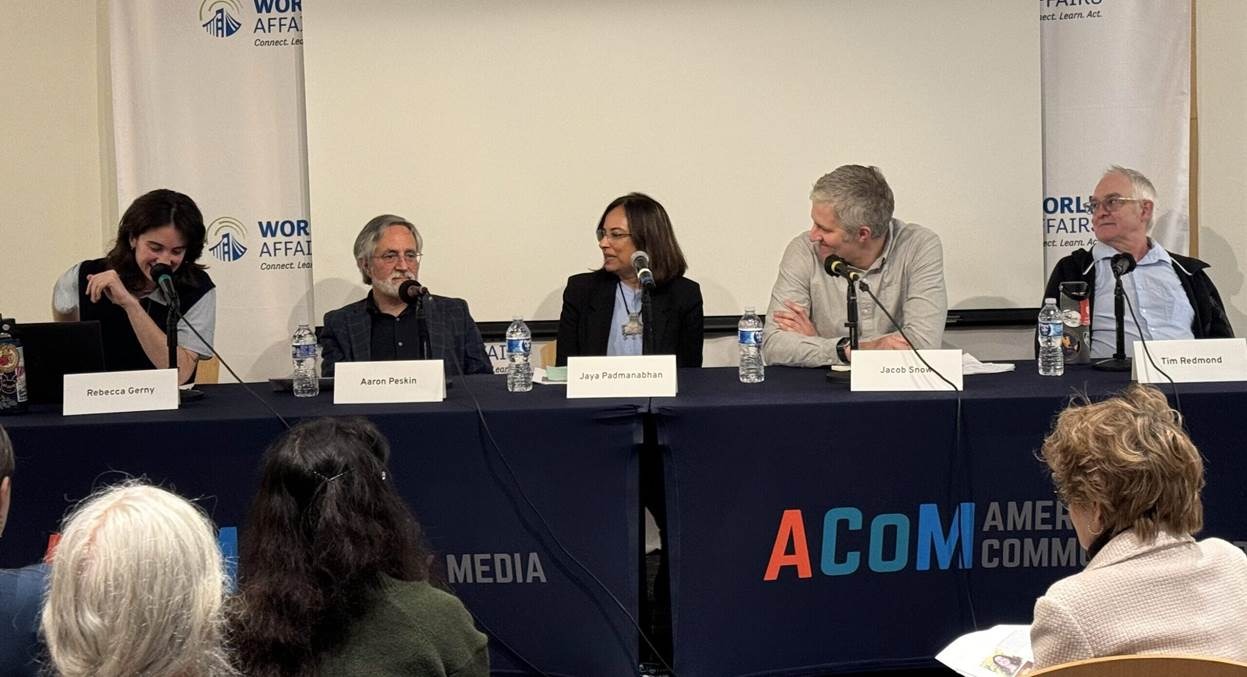
Left to right: Rebecca Gerny, Aaron Peskin, moderator and American Community Media Executive Director Jaya Padmanabhan, Jacob Snow and Tim Redmond at a February, 27 ACoM and San Francisco Local Media Coalition panel at the World Affairs Council in San Francisco. (Photo by Jessica Martin)
SAN FRANCISCO, CA — As the federal government expands surveillance technology, Bay Area communities are weighing the impact on civil liberties and immigration protections.
Berkeley and San Francisco — long known as sanctuary cities that limit local police cooperation with federal immigration enforcement — are set to revisit votes on expanding flock camera license plate readers and other privately owned technology.

Former San Francisco Supervisor Aaron Peskin explains how a 2019 ordinance he authored made San Francisco the first U.S. city to ban the use of facial recognition technology by local agencies. (Photo by Selen Ozturk)
A decade-old California law, SB-34, prohibits state and local police from sharing license plate reader data with out-of-state and federal authorities, including Immigrations and Customs Enforcement (ICE) and Customs and Border Patrol (CBP), but massive violations have been documented statewide.
A February 26 class action lawsuit against Flock Safety filed by an Oakland-based firm alleges that in San Francisco alone, Flock allowed out-of-state agencies to illegally access the police department’s database over 1.6 million times over seven months.
Disputes now unfolding in Berkeley and San Francisco reflect a broader question: Whether local sanctuary protections can survive in an era of privatized surveillance networks and aggressive federal data collection.
“There’s a dynamic tension … we have to balance. It is, on the one hand, wanting to have a safe society, and on the other, safeguarding our constitutional rights in an atmosphere where irresponsible people — many of them with financial incentives, be they the Peter Thiels of Palantir or demagogic politicians — like to trade in the politics of fear because it’s extremely effective.” said former San Francisco Supervisor Aaron Peskin at a February 27 panel on surveillance technology at the World Affairs Council.
In 2019, San Francisco became the first U.S. city to ban the use of facial recognition technology by local agencies including law enforcement.
In early 2024, then-Mayor London Breed signed legislation watering down this ordinance and allowing the police department to install and use 400 flock cameras citywide.
The ordinance, which was authored by Peskin and had won an 8-1 vote, also included a use policy requiring the local government to disclose how surveillance technology is used, stored and shared, and allows city administrators like the mayor and board of supervisors to turn down any purchase of new surveillance technology.
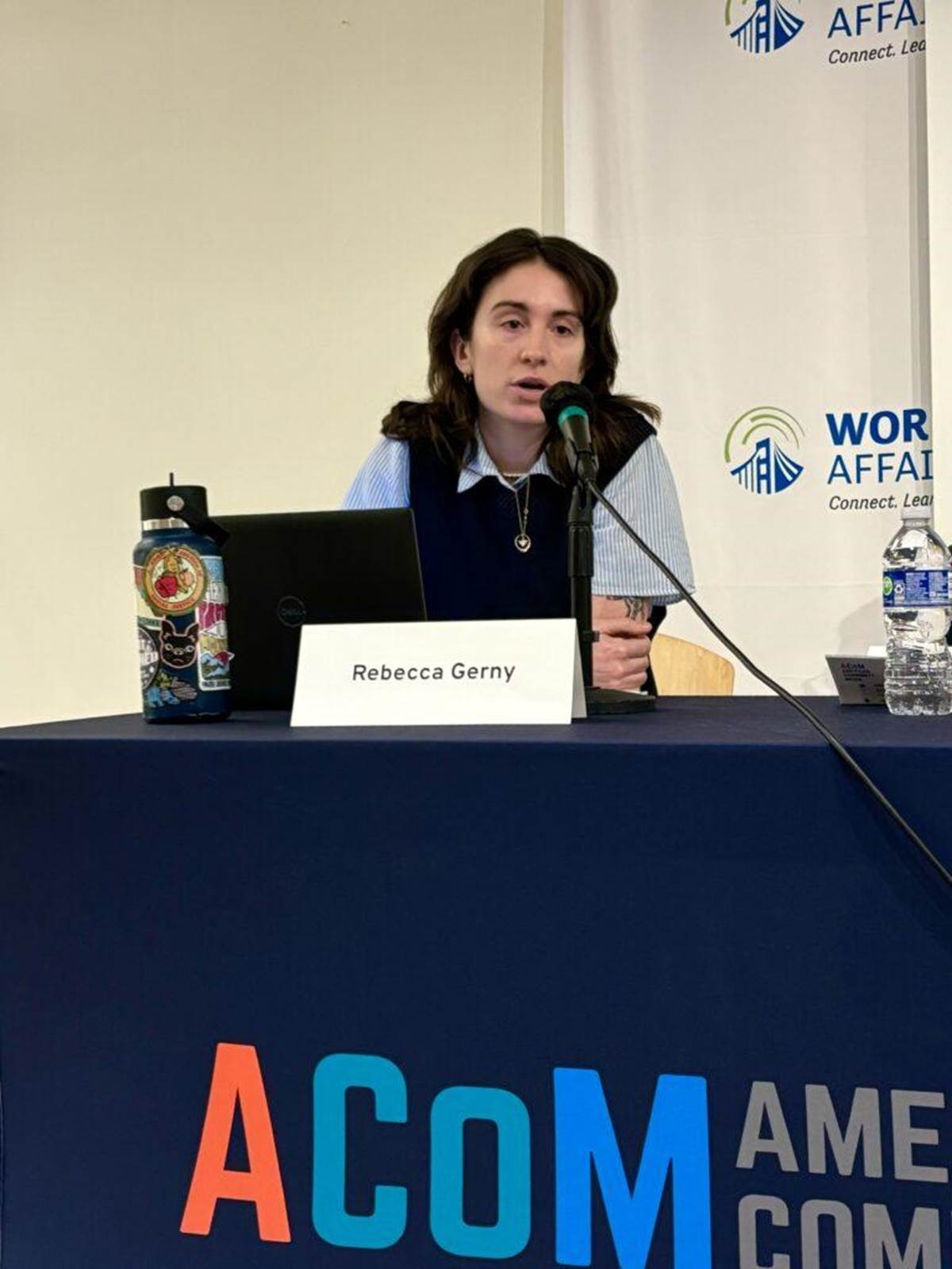
Rebecca Gerny, development coordinator at East Bay Sanctuary Covenant, describes a Berkeley City Council resolution to roll out a new Flock network of fixed surveillance cameras. The vote, originally scheduled last September, was postponed until this March. (Photo by Selen Ozturk)
But since the law was passed, “We approved over 100 different surveillance technologies. We did not turn down one,” said Peskin at the panel, which was organized by American Community Media and the San Francisco Local Media Coalition.
The ban stemmed from documented bias in facial recognition algorithms, which have disproportionately misidentified people of color.
One year before the ordinance was passed, the American Civil Liberties Union (ACLU) found that Amazon’s facial recognition technology “Rekognition” mismatched 28 members of Congress with 25,000 publicly available arrest photos from a mugshot database. Roughly 39% those mismatched were lawmakers of color, who only comprise 20% of Congress.
AI facial recognition, surveillance camera and predictive crime mapping tools are disproportionately applied to Black, Latino and immigrant neighborhoods. One erroneous match or unlawful data transfer can mean detention or deportation for someone with no criminal history.
“My hometown in Berkeley was the first sanctuary city. San Francisco was not far behind. And what did we learn from sanctuary cities? We learned that it made communities safer … that having that level of transparency meant that people were actually willing to go to law enforcement,” said Peskin.
Berkeley’s law enforcement operates 52 plate-reading flock cameras. In 2025, the city disclosed — buried in a surveillance technology report — that the police limited access to the city’s automated license plate reader data after seeing that the city appeared in three statewide searches that mentioned ICE or CBP in the search terms.
“That’s pretty low in terms of usage in San Francisco and in Oakland … but the kind of violations of our constitutional rights to privacy right now means that we don’t believe that any contractual safeguards will really prevent the federal government from accessing this data if they want it,” said Rebecca Gerny, development coordinator at East Bay Sanctuary Covenant (EBSC).
At a Berkeley city council meeting last September where EBSC advocated alongside 50 to 100 community members for a resolution to reaffirm sanctuary protections, a concurrent vote on a resolution to roll out a new Flock network of fixed surveillance cameras — different from the plate-readers — was postponed until this March.
The Flock resolution also includes a policy to “use drones at mass gatherings for possible criminal activity,” Gerny explained, and an opt-in program for households to integrate their cameras, like video doorbells, into the Flock database.
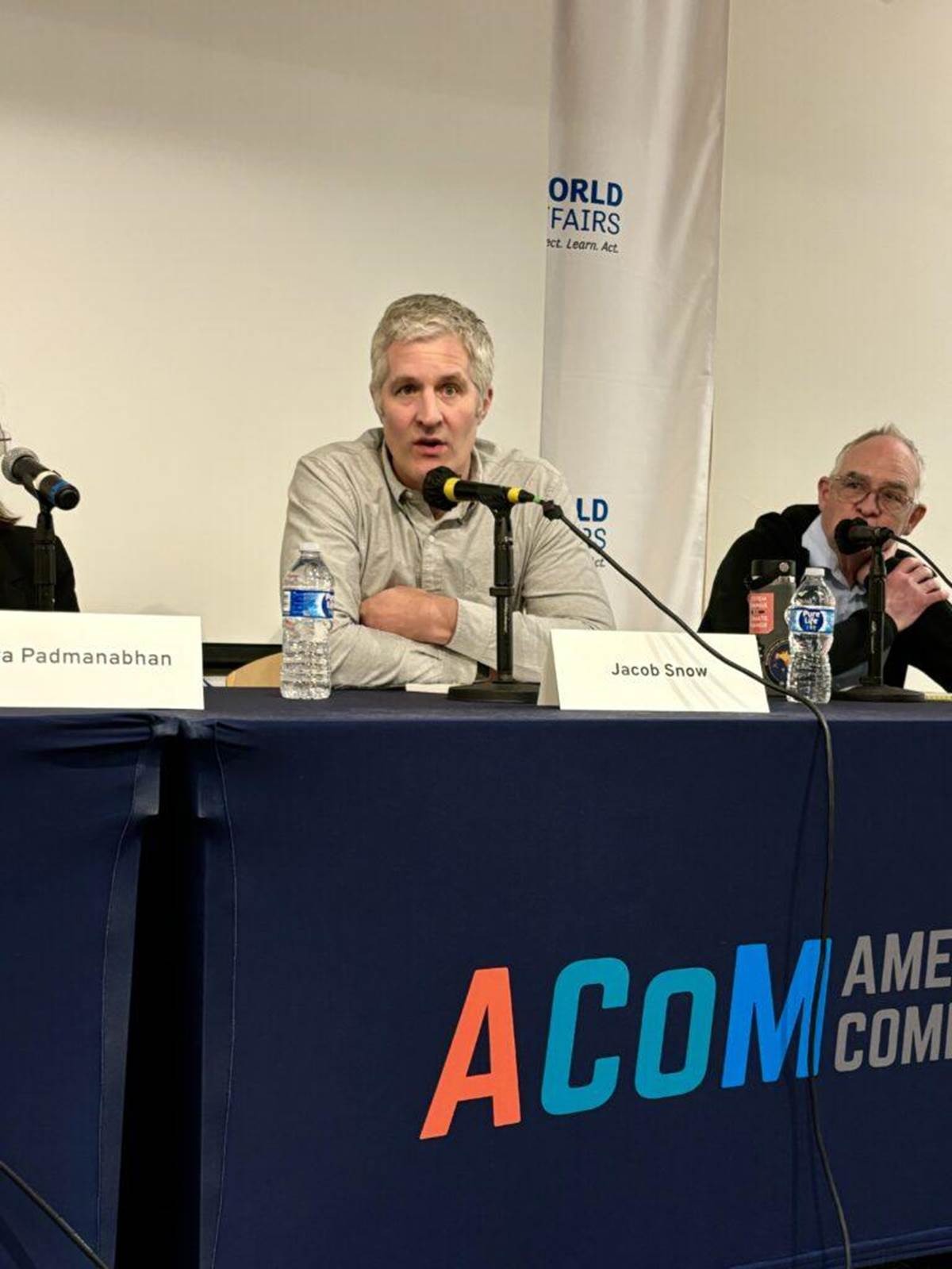
Jacob Snow, a senior staff attorney with the ACLU of Northern California, describes the litigation process in response to SB-34 violations by police departments statewide. (Photo by Selen Ozturk)
As for contentions that this technology is required to preserve public safety, Gerny said local crime is trending downward.
The Berkeley Police Department’s Transparency Hub reported 8,800 crime reports in 2025 — a 12% drop from the previous year, and the second year of a major plummet since a spike in 2023, which saw 11,652 reports.
This includes a 75% drop in homicides (one, following four the previous year), 50% for shootings, 50% for vehicle thefts, 20% for robberies, 17% for burglaries and 11% for felony assaults.
“Surveillance does not keep communities safe,” said Gerny. “It’s trust — if you are a victim of domestic violence, you can call the police, if you have unsatisfactory immigration status, you know you can still use the hospital or go to school.”
Jacob Snow, a senior staff attorney with the American Civil Liberties Union (ACLU) of Northern California, said litigation has become one of the few effective tools to enforce those trust-based protections when local safeguards fail.
After documenting repeated SB-34 violations by police departments statewide sharing flock camera data with out-of-state agencies, the ACLU sent warning letters to 70 offending agencies.
Even after the California Attorney General issued guidance clarifying that this sharing was illegal, Snow said much of it continued: “Eventually, we had to file suit.”
“You can’t take this information and assume it will just stay in your community,” he said. “People like to say all politics is local; well, all surveillance is global.”
He also described a recent case in which the Department of Homeland Security used an administrative subpoena — a demand not requiring a judge’s approval — to pressure Meta into revealing the identity of an anonymous Instagram user who had reposted a video criticizing a Border Patrol agent’s activity in last year’s Los Angeles immigration raids.
A notice from Meta told the user: “‘You have 10 days to go to court, file a motion, or we will turn over your identity,’” Snow explained.

Journalist Tim Redmond explains the private sector’s role in surveillance infrastructure. (Photo by Selen Ozturk)
The ACLU sought an emergency order in federal court to block Meta’s disclosure. In that case, and later in two similar ones, all filed in San Francisco — DHS withdrew the subpoena after it was challenged.
The Department of Homeland Security (DHS) has said that recording law enforcement as they do their duties — which has been repeatedly ruled by federal courts as protected by the First Amendment — “sure sounds like obstruction of justice.”
“What that indicates is they are trying to push these subpoenas to unmask people, and then when they are challenged, they give them up so they don’t have to face any accountability,” said Snow.
While much of the surveillance debate has centered on public agencies, journalist Tim Redmond argued that the private sector’s role in surveillance infrastructure may pose an even greater threat.
He pointed to a late 2019 investigation where the New York Times acquired over 50 billion app-derived location pings from over 12 million Americans’ devices — all leaked by sources from just one private company. From this data, reporters were able to reconstruct peoples’ daily routines including trips to workplaces, partners’ homes and medical clinics.
“Take that and put the flock cameras on top of that, and now they really know where everybody is all the time,” said Redmond. “A lot of people don’t trust the government … I trust the private sector a whole lot less. I trust the privatization of information a whole lot less. At least with the government, we can go to the board of supervisors meeting … We can pay attention. You’re not doing that with Flock.”
“Follow the money. This is all about money,” added Peskin. “Yes, our civil rights are being violated along the way, but it’s all about making very, very rich and powerful people even richer and more powerful.”
This article originally appeard in American Community Media


