
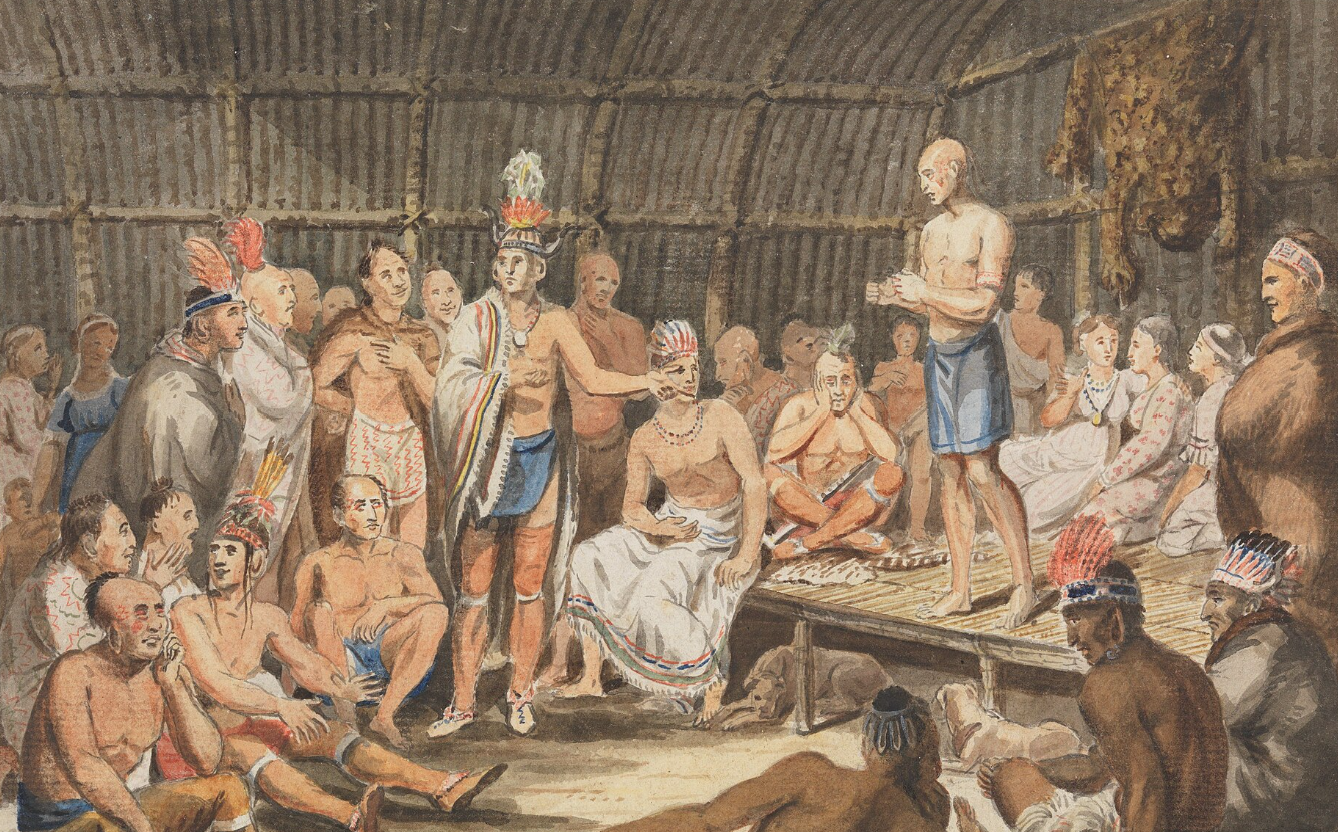
Photo: Exhibition of Indian Tribal Ceremonies at the Olympic Theater, Philadelphia - watercolor attributed to John Lewis Krimmel, formerly attributed to Pavel Petrovich Svinin, Wikimedia
When I applied to the John S. Knight Journalism Fellowships at Stanford last year, I knew I wanted to spend my time focusing on my own tribe, the Salinan, our history, our kinship networks as well as other non-federally recognized tribes like ours. Some of these tribes have members with legitimate Native ancestry and documentation, but lack the trust status enjoyed by other tribal nations. This legal status makes it possible to receive support to revitalize language, legally repatriate any remains or artifacts of our ancestors and possibly enter into compacts to build healthcare systems that would benefit our people.
There are a lot of reasons for that-the main one being the Mission system that tried to ravage our culture and language. That is a reporting project that cannot be summed up in a podcast or one investigative series, but is a lifetime’s worth of work.
In California, there are more than 100 tribes that have federal recognition-a trust relationship with the United States Government. And, there are more than 50 who do not. To understand and cover California’s Indigenous people as a reporter is to understand the complexities of both populations. That’s why I chose to focus on Indigenous identity during my time at the fellowship.
One of the first things I discovered is a long history of people who take advantage of this complex situation and claim an Indigenous identity they don’t have.
In California, I believe the history goes back to 1928 when Indigenous people were asked to sign up on the California judgment rolls to claim compensation for land California Indians lost when 18 treaties weren’t ratified by the U.S. Senate in the 1850’s.
This practice of self-Indigenization continued into the late 1960’s and throughout the seventies in the heyday of the new age movement. One man who gamed the system was Paul Olivas who called himself Semu Huate.
He started a commune called Red Wind because he wanted people to see how real Native people lived. He also claimed he was, “the last full blooded Chumash.”
He wasn’t.
I wrote about his legacy and an allegation of abuse with Dina Gilio-Whitaker for High Country News this month in a new story titled: The Facade of the Red Wind Commune.
I was drawn to Gilio-Whitaker’s work after I read her book, Who Gets to Be Indian: Ethnic Fraud, Disenrollment, and Other Difficult Conversations about Native American Identity.
I was surprised to learn that the Red Wind Commune was right in my backyard in San Luis Obispo County. I knew I had to learn more about this place. Who went there? Did my mom or any of my other relatives get caught up in Olivas’ lie? They didn’t, but since the publication of this article, I’ve seen many people comment on social media that they remembered Red Wind.
These questions are why I drove down to Southern California to visit Gilio-Whitaker where she graciously served me lunch and talked with me about her reporting for the book and our mutually shared belief that self-Indigenization needs to be talked about and called out for what it is: harm.
Olivas inspired a generation of people who claim to be California Indian, but who have no real proof or documentation. It does real, lasting harm to tribes like mine-the Xolon Salinan, the YTT Chumash and other non-federally recognized tribes that fight to be seen and taken seriously in this state.
Red Wind was one of countless communes that sprouted during the counterculture of the 1970s and later, offering the promise of spiritual fulfillment, cultural connection, community, and “authentic” Native American culture. It was a place Native and non-Native people gathered for years, believing they were immersed in traditional Chumash culture. In reality, they were enmeshed in a mix of falsehoods and half-truths that has had lingering impacts in the region and beyond.
At the end of a chapter titled Indians, Hippies and Shamans Oh My!, Gilio-Whitaker talked about her personal experience and how she was drawn to the kind of Pan-Indianism people like Olivas practiced. She wrote about a lack of connection to her own culture and displacement she and many other Indigenous people felt after decades of failed Indian policies.
Even though Olivas, AKA Semu, passed away in 2004 and his Red Wind Camp in San Luis Obispo County ceased to be a “Chumash” gathering place, his legacy as a legitimate Chumash person remains among some people despite documented evidence that contradicts his claims. Olivas/Semu mentored or influenced people who today falsely claim Chumash and Native ancestry and lead non-profit groups that make millions of dollars from a practice called cultural monitoring and conservation work in the state.
He’s also inspired a generation of people who claim a “Pan-Indian” identity, a mixture of beliefs from different tribes. They may participate in a Sundance, a ceremony of fasting and praying, go to a sweat lodge or claim to carry a sacred pipe or claim to be adopted into a tribe. All without knowing how the U.S. government tried to suppress Native religion and culture up until 1978.
Olivas/Semu wasn’t the only person who falsely claimed an Indigenous identity. Before I came to the fellowship, I was fortunate enough to be a contributing editor on a podcast called Love and Radio. The main subject, Michael Thompson, a former member of The Brand, AKA the Aryan Brotherhood, made wild and unsubstantiated claims about being raised by a Nez Perce man who taught him how to “shapeshift.” He also claimed to be from the Turtle Mountain Band of Chippewa. He fooled everyone-even the pardon and parole board! I and others proved he had no Indigenous ancestry.
When people are confronted over an alleged Indigenous ancestry they cannot prove, they often reject publicly available records that can verify who they say they are. I often hear this statement: those records are considered part of a “colonial system” meant to erase Indigenous people. I and others feel the opposite. Indigenous people participated in the creation of those documents. We had a voice and I am proud that my ancestors can be read and heard in them.
As Gilio-Whitaker and I wrote in our article for High Country News, the Santa Ynez Band of Chumash remains the only federally recognized Chumash tribal nation in the state, therefore conferring legitimacy. Indigenous legitimacy in California is also determined by documentation via Mission and other Spanish era records.
In the 1970s, the floodgates were opened for new waves of people without verifiable tribal heritage to claim tribal identities. By then, Nativeness had become an exploitable commodity. Red Wind attracted a wide swath of people, both opportunistic and spiritually starved, as being Indian grew in popularity. One of those opportunists was Semu/Olivas. Today, people pretending to be Native continue to exploit a system that still lacks checks and therefore accountability. These include universities, the arts and literature, and in California, people who claim to protect sacred spaces.
Salinan people still have one of the core things that make us Indigenous-our families and kinship networks, and a connection to the land, which tell us who we are and where our language comes from. That’s not something you can fake.
This essay was published first on Medium, a publication about Ideas and Insights from the JSK Journalism Fellows at Stanford.


