
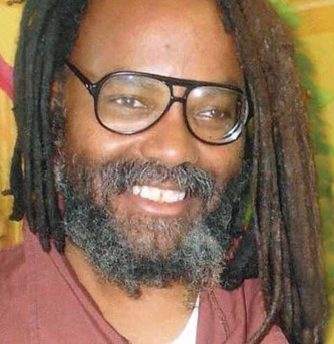
Janine Jackson: The 1982 conviction of Mumia Abu-Jamal for the killing of a police officer followed a trial marked by prosecutorial and police misconduct, shifting witness testimony and discriminatory jury selection, along with overtly biased news coverage.
Imprisoning Mumia has not worked to silence him. We spoke with him in October, and I started by mentioning how he’d been a radio reporter in Philadelphia, and head of the Philadelphia Association of Black Journalists, and I asked if he considered himself a journalist today.
Mumia Abu-Jamal: Yeah. But in a cultural sense, I think of myself as a griot, probably a progressive griot, but a griot nonetheless. In African culture, griots were the people who remembered the history of the tribe, and, really, they served the prince in power, but they served the tribe as well. And there’s an old tradition that’s talked about in Senegal that when a griot dies, you don’t lay him in the ground. You bury him vertically in a tree, so that he and his stories are remembered.
I think about telling the stories of a different kind of tribe here in America, a tribe of rebels, a tribe of people who struggle, a tribe of the poor and the oppressed, because those are the stories that rarely get heard and get reported in much of the world.
JJ: I think people read the data point, “Oh, 2 million people incarcerated in the US,” more and more every day being put in detention centers, and they’re shut away from families and friends, by procedure, by distance, but also shut out of public debate and conversation.
And I think there’s a feeling that this is a cost to those people who are imprisoned, but there’s less recognition that there’s a cost for everyone when we don’t get to hear from this ever-expanding and various group of voices. And I think journalists who buy into, wittingly or not, the idea of “out of sight, out of mind”—they’re serving someone, they’re serving something, by excluding the voices of the incarcerated in our public conversation.
MAJ: Well, yeah, they’re excluding not just the imprisoned, who, as you said, are in the millions in the United States, but also they’re excluded from thinking about what it means to be truly American, because this is part of that. There is no space in the American landscape where the shadow of the prison doesn’t fall.
And that’s because it is so huge. It is so vast that it impacts those within and without. Because everybody in prison has someone on the outside of prison that loves them or they love: their children, their mates, their parents, you name it. And that shadow falls on all of those people. There are stories that can enrich our understanding of what it means to be human by allowing people in this condition to be heard as full human beings.


