
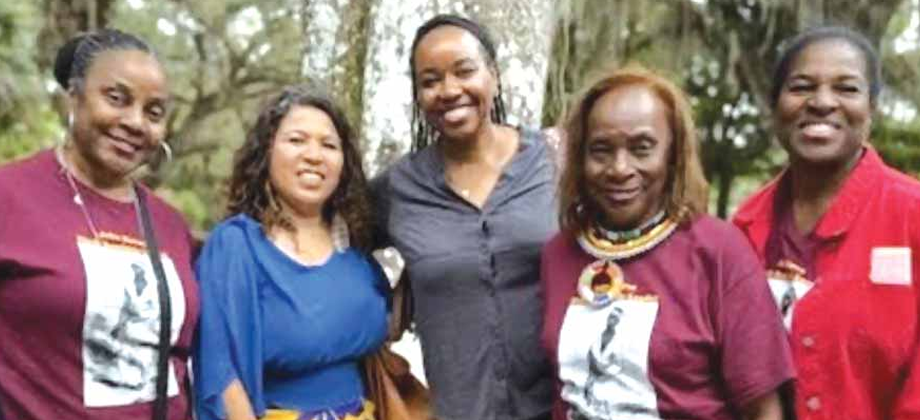
Photo: Michelle Riley, Corina Torralba, Windy Goodloe, Dr. Wallis Tinnie, and Antoinette Riley at the 188th Anniversary Annual Seminole Maroon Spiritual Remembrance of the Two Battles of the Loxahatchee River
This proverb appeared in the booklet that was given to guests who attended the 188th Anniversary Annual Seminole Maroon Spiritual Remembrance of the Two Battles of the Loxahatchee River, which is the Florida Black Historical Research Project Inc.’s annual event.
This year, the event began on Friday, January 16, with a reception that was held at the Historic Tabernacle Church in West Palm Beach, FL, which was hosted by the Honorable André Odenbreit Carvalho, the Consulate General of Brazil. That evening, the movie Quilombo was screened. Directed by the late Carlos Diegues, Quilombo, which is set in Brazil, depicts the settlement of formerly enslaved people who must fight to maintain their freedom from encroaching Portuguese enslavers. (Unfortunately, I wasn’t able to attend this first event.)
The following day (Saturday, January 17) was a full day of films. These screenings were also held at the Historic Tabernacle Church. Kicking things off was the screening of the short documentary Freedom Seekers: The Black Seminole Story. This documentary is close to my heart because it features my community and many other locations within the Black Seminole diaspora. Dr. Anthony Dixon, who is the writer, director and producer of the film, sought to have Black Seminoles tell their own stories and to be producers of the film as well. I believe he has achieved his goal. After Freedom Seekers, we watched The Hidden Black Society They Don’t Teach You About: The Great Dismal Swamp. This short film discussed the history of the Great Dismal Swamp and its inhabitants. Next, we watched Cimarrones, which was an excellent short documentary about the maroons of Peru. This was followed by Raised by Water, Held by Land, which is a fifteen-minute film directed by Ania Freer featuring the voices of Daniel Tommie and Dr. Wallis Tinnie. Following this film, we watched Through the Flowering Place. Directed by Clare Vickery, this short film explores the lives of six women of color who successfully gained freedom. Then, we watched Capital of Earth: The Maroons of Moore Town. This documentary showcased the lives of the Maroons, who are “direct descendants of self-liberated formerly enslaved Africans who formed rebel communities in the Blue Mountains.” The last documentary that we watched before we had an intermission for the day was titled For Humanity: Culture, Community & Marronage and featured the people of San Basilio de Palenque who have maintained a resilient African culture, following their ancestors who escaped from slavery and the formation of their own community.
Later that evening, we returned to the church and watched Maluala. This film was directed by the late Sergio Giral, who was known as the Father of Black Cuban Cinema, and depicts formerly enslaved freedom seekers who hid in the mountains and overpowered their former Spanish masters.
The next day (Sunday), we gathered at the Loxahatchee River Battlefield in Riverbend Park for the Seminole Maroon Annual Spiritual Remembrance and Battlefield Tours. This was where Mr. Gene Dinizulu Tinnie spoke the phrase that begins this article and said that it is meant to “honor the memory of all of the fallen in the two pivotal battels of January 1838 and in the quest for freedom in Florida and beyond.”
The annual program began with Raining Deer, who is Iyeska and Powhatan and is a member of the Cox Osceola Seminole Tribe from Orange Springs, FL, “opening the way.” With sage burning, her beautiful voice echoed throughout the park as she invited everyone to open their hearts and minds. Next, Mr. Gene Tinnie spoke and poured ceremonial African libations. And a beautiful Seminole Maroon invocation was performed by flutist Blanche Williams who spoke beautifully and powerfully before she began to play. While she was speaking, she invited the audience to participate by saying the word ashé/ase, which is a Yoruba word that means “so be it.” Each time we said this powerfully healing word, there was an adorable four-year-old girl sitting next to me who first whispered it and then confidently said it out loud. It was amazing to watch her learn a new word and then feel comfortable enough to say it along with everyone.
Dr. Iqbal Akhtar recited a traditional Muslim prayer called “The Fatiha.” Following Dr. Akhtar, the drummer Mustafa Wright set up several of his drums and played. While he was playing, he also invited the crowed to say ashé/ase, and the same little girl confidently repeated the word, her little voice standing out among crowd. When Mustafa heard her, he invited her to join him and play a rhythm on the drums with him, which she did. He spoke about how important drums (and instruments and music) are and how drums had saved his life.
Next, Derek Hankerson, who is the president of the Loxahatchee Battlefield Preservationists (LBP) spoke. He was followed by Prof. Magdalena Lamar and Dr. Anthony Dixon who had a joint conversation about the Negro Fort. Mr. Glenn Bakels, who is the former LBP president, spoke about the days leading up to these two significant battles of the Second Seminole War and what happened during each battle. Then Thomas Mitchell, who is a descendant of several people who were at the Negro Fort, spoke. And we closed out the program with a beautiful final performance by Blanche Williams, who was joined by her friends Mustafa Wright and John Many Horses. She invited us to place our hands over our hearts and close our eyes while she played.
Following the program, we enjoyed a light lunch and were entertained by an overly friendly racoon who was waiting for someone to drop some food. We also did what we do every year, which is catch up with dear friends and take a ton of pictures before saying goodbye.
What the Tinnies have created with this beautiful annual event is nothing short of magical. They’ve created a space where we can come together and learn and discuss and heal.
Human Generated


