

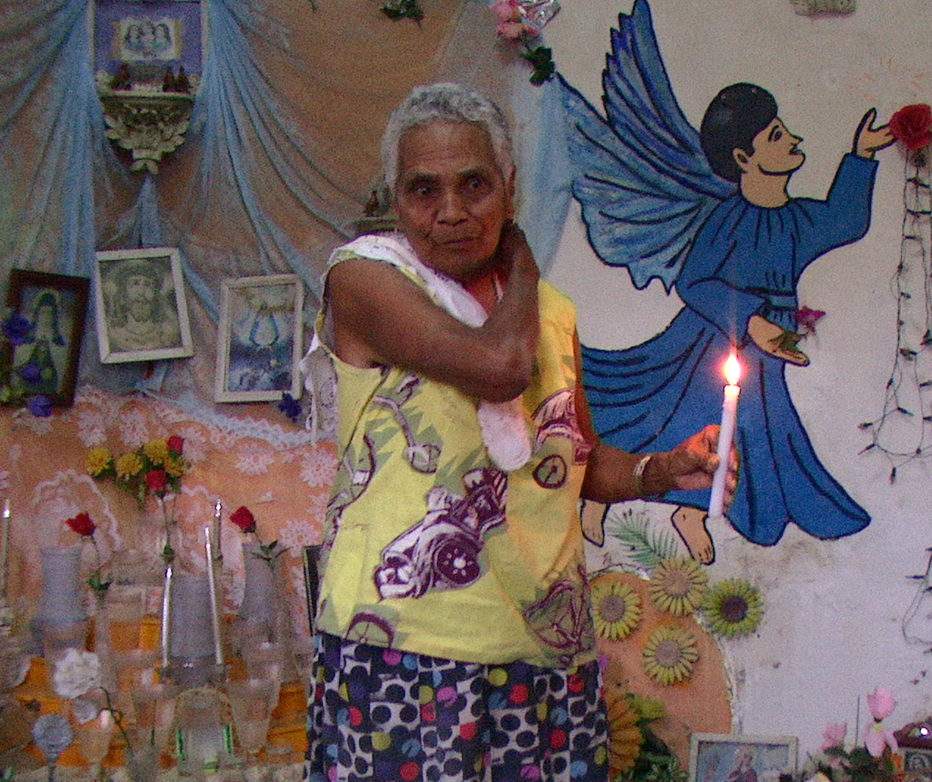
Photo: A Mardi Gras Indian, with Christian imagery, 2010, New Orleans, by Karen Apricot, Wikimedia
In New Orleans, there are Black holiness churches where Sauk and Fox Tribal leader, Black Hawk, is worshipped.
When Roman Catholics and Orthodox Christians recite their belief in the Communion of Saints, they celebrate a holy meal with all believers, past and present, living and deceased. This sounds like fellowship with the ancestors, yet the Bible also forbids eating food offered to idols.
How do Indigenous people who practice Christianity reconcile their non-European spiritual beliefs with the doctrines of the European and Euro-American Christian Church?
Where do the beliefs and practices of Indigenous communities intersect with the Abrahamic religions of Islam and Christianity, the two Abrahamic faiths that actually seek converts, and have even forced conversions in the past?
As the Abrahamic faiths confess a belief in one God, who revealed Himself (and I do mean Him) to the patriarch Abraham, they have had a troubled relationship with beliefs outside their holy books, including those that foreign wives into the community.
While decrying “pagan” beliefs of non-Abrahamic faiths, missionaries are often blind to the animistic and earth-centered beliefs that entered their faiths centuries ago. The Holy Communion, advocated by Jesus himself, harks back to actual sacrifices in which the victim (an animal or even a human) was eaten by the community. Jesus was invoking the rejected practices of his Afro-Asiatic ancestors, which even earlier, Abraham had rejected.
Early Christianity spent little time trying to eradicate pagan culture. The early Church was more concerned with promoting Jesus as savior, rather than obsessed with the many pagan beliefs already circulating in Roman society. Even with many early Christians being converted Jews, the Apostle Paul did not even require non-Jewish converts to practice Jewish dietary laws, though Christianity was mostly based on Jewish prophecies.
Centuries later, Indigenous non-Europeans would enter the Christian fold, mostly by force. Yet the converts still read between the lines and felt that the spiritual realm still spoke through the gospel of Jesus Christ. Parts of the Euro-Christian Bible were used as spells to work out the needs and desires of believers, outside the approval of White church authorities.
In Santeria, the names of Catholic saints were attached to Yoruba deities. This process is called syncretism. Santeria is neither wholly Christian nor entirely African. It is something new.
But there is probably more syncretism within the official churches than outside it. As humans we live in both, as an all-knowing Deity certainly knows already.


.jpg)