

Photo: Francisco Lozano drives through Santa Maria, Calif. on Nov.23, 2025. Credit: Julie Leopo
It was around 2010 that Francisco Lozano first noticed the gangs proliferating in Santa Maria, a largely immigrant enclave along California’s Central Coast. Worried for his son, Lozano decided the best way to keep him safe was to get involved with his school.
Since then, Lozano has become a bridge between the district and the Indigenous Mixtec community, a large and, until recently, mostly invisible segment of the population here.
“I didn’t want to see my son out on the streets with the gangs,” he said in Spanish. “I thought, ‘I need to do something. I need to get involved in the school.’ So, I started looking into what I needed to do to make that happen.”
At the time, El Camino Junior High School, where Lozano’s older son was enrolled, had been searching for a vice president for the school council. Lozano put himself forward and was voted in.
It wasn’t long before he noticed a troubling pattern: local Mixtec families would attend school meetings, but their voices were often absent. The discussions unfolded in Spanish, yet many Mixtec parents, some of whom speak only limited Spanish, were unable to fully understand or participate.
“The Mixtec community was there, but it was invisible,” Lozano recalled, citing a lack of interpreters that made it nearly impossible for Mixtec parents to communicate with teachers or advocate for their children.
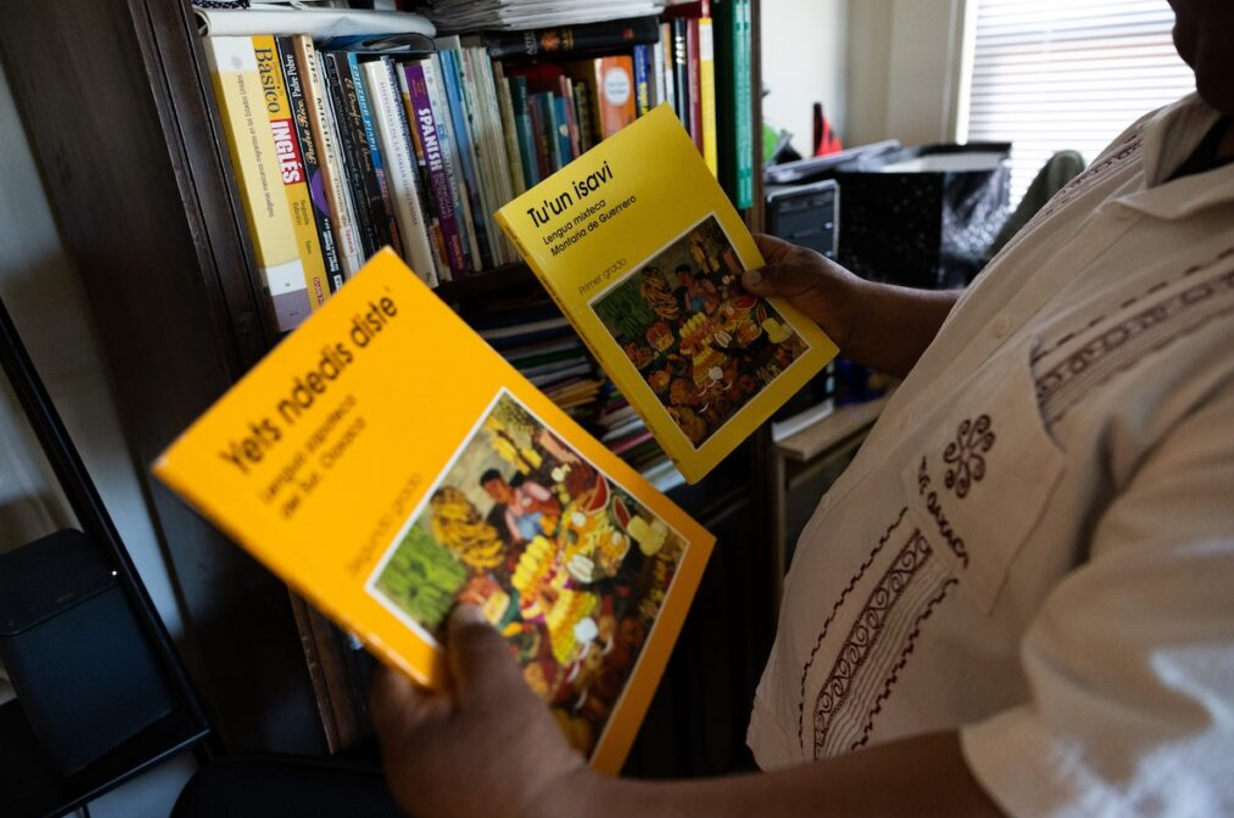
Francisco Lozano holds Mixteco-language books from his home library on Nov. 23, 2025, in Santa Maria, Calif. Credit: Julie Leopo
Data show that some 15-20% of families in the Santa Maria-Bonita School District list Mixtec, an Indigenous language widely spoken across southern Mexico, as their primary language. Overall, some 60% of the city’s residents speak Spanish as their primary language.
For Lozano, the Mixtec community’s silence became a call to action.
He pressed the School District to introduce trilingual interpretation—English, Spanish, and Mixtec—for all public meetings across Santa Maria schools, arguing language access is essential for equitable participation. The change allowed Mixtec parents to participate more fully in the school’s decision-making and communicate directly with teachers, providing them with a fair opportunity to advocate for their children.
“As parents, we have every right to advocate for our children, for better academic learning or healthy food,” he said.
What started as a program focused on parents later expanded to include classroom interpretation, allowing children whose primary language is Mixtec to receive language support as well as additional after-school tutoring to fill learning gaps.
For Lozano, cultural identity is key to academic achievement: “Our language is in our mind, but it’s also in our hearts. Our language has cultural richness. It’s our identity.” His goal is for Mixtec children to continue practicing the language while also progressing in their academic studies.
“One way or another, they must pursue a career, whether they become doctors, engineers, psychologists, or whatever it is, they must become something. Our children must attend university, because white people have master’s degrees and doctorates, so why shouldn’t our children?” he explained.
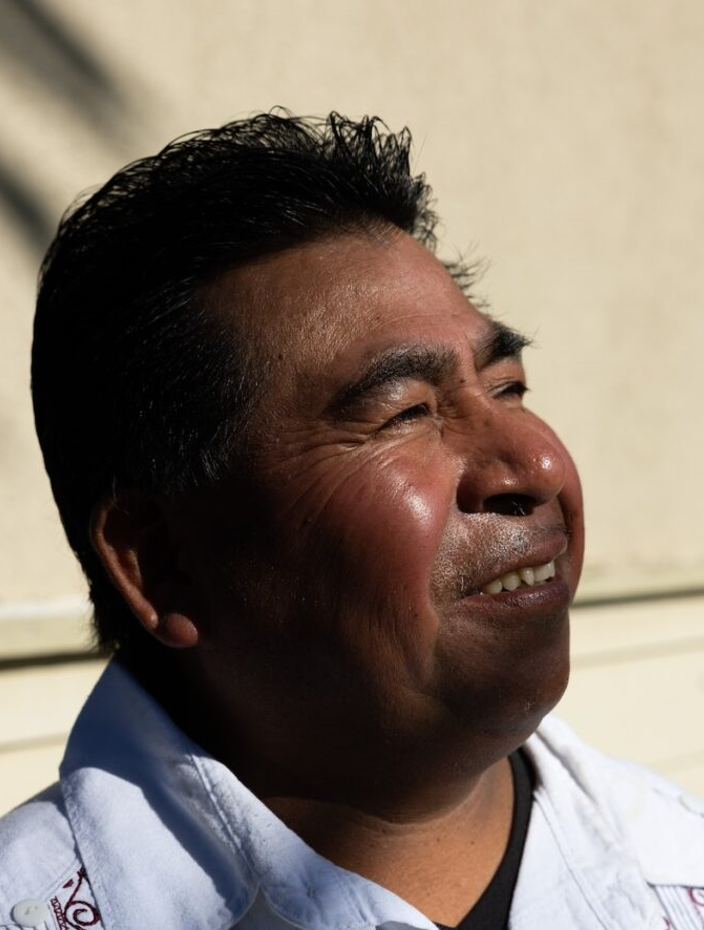
Francisco Lozano has lived in Santa Maria for over two decades. Credit: Julie Leopo
While the data on Mixtec student achievement is sparse, researchers cite language and cultural barriers as key challenges.
Lozano’s advocacy includes organizing private meetings with Mixtec parents, emphasizing the importance of supporting their children to pursue higher education. He consistently seeks ways to show parents that the world isn’t closed off to them. Rather, the key is actively guiding their children toward opportunities that can make attending university a reality.
That has been his motivation for 15 years, and he has seen the fruits of his efforts.
Maria Carrillo first met Lozano during a meeting at Santa Maria High School. Hearing him speak Mixtec, she said, gave her hope to continue attending the gatherings.
Carrillo later learned that the high school had Mixtec interpreters available for parents, a service that proved crucial when her youngest daughter struggled academically during the COVID pandemic.
“I thought she wasn’t going to graduate from high school,” Carrillo said. With support from a school counselor and communication facilitated through a Mixtec interpreter, she had the tools to help her daughter. Not only did her daughter complete high school, but she also went on to enroll at California State University, Sacramento, where she is now studying law.
“Thanks to him, she graduated and now she’s going to university,” Carrillo said. “Without him, I wouldn’t have known where to find help.”
Lozano’s advocacy is recognized by local officials, including Tammie Castillo-Shiffer, director of the Multilingual Services Department at Santa Maria-Bonita School District. “His help has definitely shaped the way that we interact with families,” she said.
In 2008, when Castillo-Shiffer began working with Lozano, she said many Mixtec-speaking families struggled to engage with the school system. Unfamiliar processes and English-only automated messages left parents without access to essential information, while their children faced challenges such as bullying, gang activity, and drug exposure.
To address safety concerns, the district partnered with the Santa Maria Police Department to create the Mixtec Community Academy, where interpreters allowed families to ask questions directly. Lozano played a central role in bringing parents into the room and elevating the issues they were experiencing.
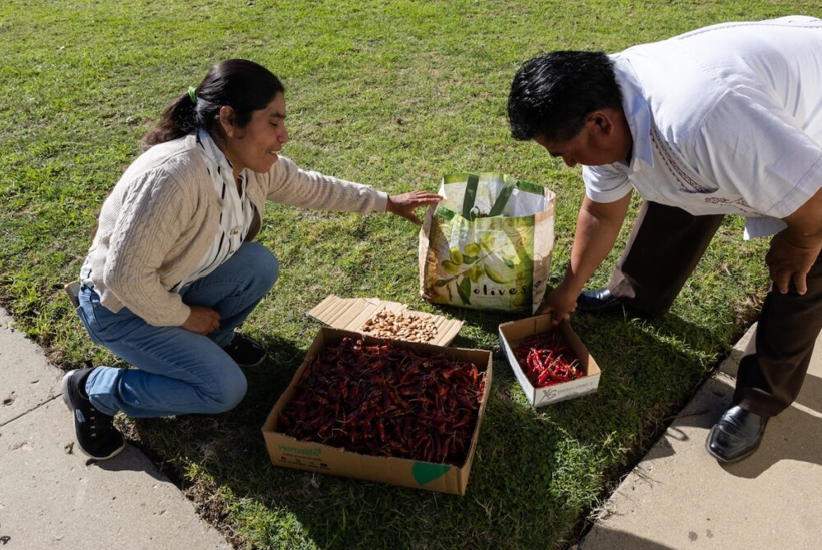
Maria Carrillo dries chillis in front of her home in Santa Maria. Carrillo says Lozano’s advocacy was key to her daughter graduating. Carrillo’s daughter now studies law at Cal State Sacramento. Credit: Julie Leopo
As the district deepened its work with the community, staff learned that Mixtec is primarily a spoken language. In response, they began adding QR codes to informational flyers that link to Mixtec audio recordings, and they shifted calls to evening hours to better align with parents’ work schedules.
As the district deepened its work with the community, staff learned that Mixtec is primarily a spoken language. In response, they began adding QR codes to informational flyers that link to Mixtec audio recordings, and they shifted calls to evening hours to better align with parents’ work schedules.
The district also broadened its outreach through a half-hour education program on Radio Ranchito, covering topics such as special education and English-learner testing. Each segment is translated into Mixtec so families can access the information at home or while listening at work. Castillo-Shiffer noted that this approach grew directly from Lozano’s advocacy and
the practical insights he brings from the community, consistently pushing the district to meet families where they are.
At Lozano’s urging, and inspired by his son’s own college path, the district also launched college-going workshops to support students’ academic futures.
Castillo-Shiffer describes Lozano as a hands-on, energetic partner who doesn’t simply offer ideas; he brings them to life. He’s constantly out in the community, inviting parents, sharing flyers, and finding creative ways to reach families. When concerns arise, he often brings parents to her office, ensuring those who need guidance have a place to be supported.
“I’m really honored to have worked with Mr. Lozano,” she said.
Lozano first arrived in the United States at age 14 and began working in the strawberry fields that dot the local landscape. Although he was given work immediately, no one told him he had the option of attending school, he recalls. Over time, he found his way into public libraries, where he discovered a love of books—books that helped him learn Spanish, expand his knowledge, and ultimately become an avid reader.
That experience shaped many of his beliefs about learning and parenting. One of his guiding philosophies, he says, is that “love is not only in a hug or in a kiss but in the words that we express.”
For him, offering his children kind and reassuring words is essential to helping them thrive. He now works to share that message with other Mixtec families, inspiring a shift toward “new ways of raising our children and talking with them.”
Today, Lozano serves as president of the Mixtec Parents’ Advisory Committee in Santa Maria and has received several recognitions for his advocacy, including the 2016 Legado Latino, and the Santa Maria-Bonita School District “Key to the District” award.
“As children grow, they are like a flower that blooms, with colors, with life,” says Lozano. “As parents, we must nurture that flower so it can grow, and it will grow, their knowledge will flourish, their skills will develop, not just for themselves, because when they bloom, our community blooms too.”
This story was produced in collaboration with Tu Tiempo Digital in Santa Maria. Roxsy Lin is a California Local News Fellow with the UC Berkeley Graduate School of Journalism.


