
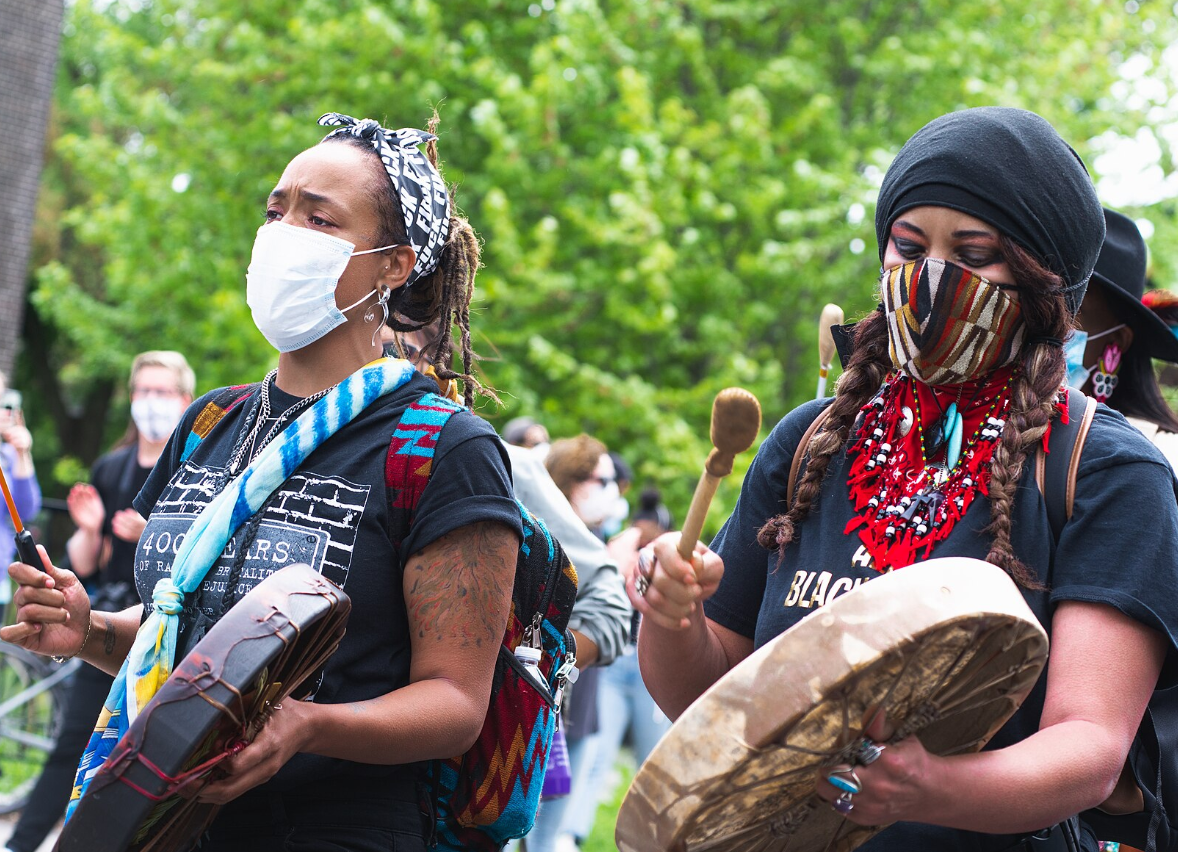
Photo Justice For Regis - Not Another Black Life rally and March - May 30, 2020, Toronto- Creative Commons Photos, Wikimedia
cting, not waiting.Local journalism in California has been shrinking. The Medill State of Local News Report warned that the number of counties with no local newsroom grew to 213 in 2025; together with another 1,524 counties served by only one outlet, that means about 50 million people have little or no access to local news. These “news deserts” will not vanish on their own. As Indigenous and immigrant reporters, we cannot wait for perfect grants, towers or studios; if we delay, our stories and voices disappear. We must begin wherever we stand, using whatever tools we have, to connect our communities and assert our sovereignty over how we are represented.
Lessons from the Pala Reservation
Earlier this year I drove from Las Vegas to the ancestral lands of the Pala Band of Mission Indians to attend an “Indigenous Wisdom Through Media” gathering hosted by Indian Voices and Rez Radio. San Diego County is home to roughly 58,000 American Indian/Alaska Native residents who live on or off 18 federally recognized reservations, the highest concentration of tribes in the country. Around a campfire at the Pala Rey Youth Camp, more than thirty journalists, artists and activists representing Indigenous, Black, Asian, Latino, Filipino, Vietnamese, Burmese and other communities shared food and stories. We did not gather just to network; we were there to strengthen relationships and unify our voices.
The land itself reminded us why we report. The Pala Reservation has long been a place where youth gather for wellness programs and traditional bird singing. Eric Ortega of Rez Radio and John “Bud” Machado explained that restoration and preservation of the language and land require honoring traditional methods, even when they conflict with modern regulations—a metaphor for how Indigenous media must honor ancestral customs while navigating contemporary laws and censorship. The talk around the fire confirmed that our storytelling is inseparable from the land and its histories.
Stories of generational trauma and shared sovereignty
Participants shared stories that mainstream outlets often ignore. Gerardo Cota, a Kumeyaay citizen born in Tecate, was deported thirteen years ago despite his tribal ties; on the Mexican side, he was left without the medical care he needed after a childhood stroke. Melissa Pasadena of the Cheyenne Nation reminded us that in a so‑called melting pot, borders should not prevent peaceful coexistence and that Native people are often reduced to numbers in bureaucratic systems while still struggling for clean water and health care. Burmese and Hmong participants told us that refugees in San Diego, including Karen and Chin peoples, have distinct Indigenous identities and political struggles that mirror Native experiences of exile and sovereignty; they carry the weight of generational trauma from secret wars and forced displacement. These stories, rooted in shared histories of removal and resilience, underscored our responsibility to report on issues overlooked by mainstream media.
Expanding the circle
After Pala, a follow‑up invitation called on anyone involved in community or independent media—print, radio, podcast, newsletter or social platform—to gather at San Diego’s World Beat Center. The goal was to share concerns and ideas, creating a unified voice for our community. Our circles grew: a county employee who has begun learning the Kumeyaay language offered to contribute articles in that language, and participants from diverse backgrounds joined with their own stories and skills. Julian Do of American Community Media observed that while individual outlets may be small, our combined reach spans millions; by thinking horizontally across multicultural audiences, we can amplify news and attract sustainable support. Susan Santos of Filipino Press noted that the gathering fostered a shared vision for collaboration in which everyone contributes their own balance and skills. Rose Davis quoted Seminole leader Osceola: “There’s a brighter future if we unify and bring all the fingers into one fist”—a call to transform scattered efforts into a collective force.
Lessons for building sovereign media
• Start where you are. Waiting for perfect funding or infrastructure only delays our work. We must organize and share our stories now.
• Honor language and culture. For some, that means producing emergency information and news in Indigenous languages; for others, it means reporting through the lens of our ancestral traditions.
• Expand the circle. By working side‑by‑side across Indigenous, AAPI, Latino and African diaspora communities, we can amplify news to millions and draw sustainable support.
• Reconnect through music and art. Cultural music whether Pala bird songs or Vietnamese monochord melodies heals trauma and unites people across borders. When we weave art and tradition into our reporting, we help communities remember who they are.
• Put faces to names. Gathering in person builds trust and lets us recognize each other’s strengths. These relationships form the foundation of a one‑fist strategy: bringing together individual fingers into a collective force.
Tribal alley and urban communities
Our struggle for media sovereignty is not confined to rural reservations. In downtown Los Angeles’ Skid Row, a block of Werdin Place is known as Indian Alley. This tiny street, adjacent to the United American Indian Involvement Outreach Center, was a refuge for indigent American Indians from the 1930s through the 1990s. It became an important locus for social, spiritual, political and rehabilitative activities, providing dormitories and support services for many displaced Indians. Since 2011, Indian Alley has been transformed into a living gallery of murals and sculpture that commemorate its significance. Tribal commissioners, urban community leaders and volunteers are working to ensure that spaces like Indian Alley remain safe and vibrant. They remind us that our movement stretches from tribal lands to city blocks; we must nurture both.
Immigrant contributions and shared journeys
Immigrants are part of this story. The American Immigration Council reports that immigrants in the United States have a combined household income of $2.1 trillion and contribute almost $383 billion in federal taxes and $196 billion in state and local taxes. After taxes, their spending power still exceeds $1.6 trillion. Many of these families are Mexican, Vietnamese, Filipino, Burmese, African and beyond, and they also carry memories of colonialism, war, deportation and forced migration. They are neighbors in our cities, allies in our newsrooms and partners in our quest for representation. By recognizing their economic and cultural contributions, we strengthen our coalition and find common ground to heal generational trauma.
Looking ahead
As a Las Vegas‑based journalist of Indian Voices, I am inspired by the resilience and creativity I have witnessed. From the firelight of Pala to the murals of Indian Alley, from elder storytellers to youth learning ancestral languages, we are forging strong connections that span tribal lands and urban neighborhoods, print journalists and podcasters, elders and immigrants. We cannot wait for perfect conditions; the work of media sovereignty and community connection must continue now. Tribal commissioners, community elders, activists and artists all have roles to play. The path we are forging is being laid under our feet; let us walk it together.
All people in the United States, regardless of immigration status, have certain rights and protections under the U.S. Constitution. The ILRC’s red cards give examples of how people can exercise these rights. However, they do not provide individualized legal advice. Community members are encouraged to check in with a trusted legal service provider for questions about their situation.
We extend our deepest gratitude for the opportunity to gather once again at the WorldBeat Cultural Center, a space founded in 1993 by Makeda Dread Cheatom that has become one of San Diego’s most important multicultural arts and event centers. Makeda transformed an abandoned water tower into a vibrant hub, producing hundreds of programs and presenting artists from a wide array of cultural traditions. Her work has earned numerous community awards, and she was inducted into the San Diego County Women’s Hall of Fame in 2012.
The WorldBeat Cultural Center is a nonprofit organization dedicated to promoting, preserving and celebrating the African Diaspora and Indigenous cultures. Under Makeda’s leadership, it offers workshops on small-scale farming, healthy “farm-to-table” cooking and holistic wellness that honors ancestral practices, preserves cultural artifacts of historical value, and provides a stage for artists to share their deepest expressions. For more than two decades, this gem has served as a gathering place where communities come together, learn from one another and keep cultural traditions alive. Thank you, Makeda and the WorldBeat Cultural Center, for your generosity and enduring commitment to unity and cultural preservation.


.jpg)