
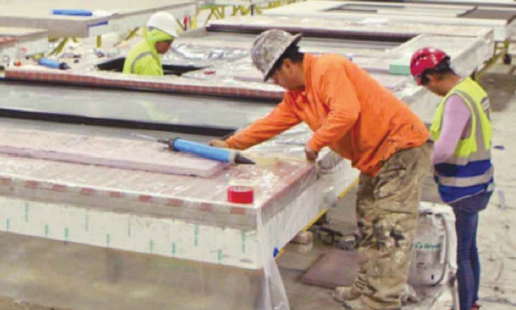
Photo: Industrial innovation on the factory floor: Assembly-line production of modern prefabricated components allows for precision engineering, material efficiency, and built-in climate resilience.Credit: Image source: Creative Commons Public Domain (CC0). Free for editorial publication.
by Julian Do, Co-director of ACoM and contributor to Indian Voices
Building a sustainable future: Integrating localized green technologies, such as solar micro grids and modular design, empowers Indigenous communities to wire, power, and secure their own economic recovery.
California is currently caught in a vice grip between two of its most pressing crises: a severe, systemic housing deficit and an escalating climate emergency. For the state’s Native American populations—both across the 109 federally recognized tribes in rural homelands and the more than 760,000 Indigenous residents navigating the urban diaspora of San Diego and the rest of the state—this manifests as a “double housing crisis”. Families face staggering rates of overcrowding and deep inflationary pressures, while their neighborhoods remain on the front lines of catastrophic wildfires, prolonged droughts, and grid instability.
The traditional response to this crisis—sluggish, fragmented, brick-and-mortar development dependent on unpredictable supply chains—is no longer viable. To close these systemic gaps, California must pivot toward a solution that sits at the intersection of industrial innovation and tribal self-determination: advanced, climate-resilient prefabricated modular housing.
The timing for this structural paradigm shift is uniquely optimal, driven by an unprecedented alignment of federal capital, state initiatives, and manufacturing incentives. At the federal level, the Department of Housing and Urban Development’s (HUD) dedicated PRICE Initiative (Preservation and Reinvestment Initiative for Community Enhancement) has unlocked vital funding specifically earmarked to revitalize manufactured housing infrastructure. At the state level, the California Strategic Growth Council (SGC) is driving the momentum through its Tribal Housing and Capacity Building Initiative, providing the pre-development and planning capital necessary to lay down the physical and digital infrastructure for these alternative developments.
However, the true catalyst lies in bridging these housing programs with the state’s broader economic development machinery. This is where GO-Biz, the Governor’s Office of Business and Economic Development, can step in to orchestrate an industrial masterstroke. By utilizing California-based prefabricated housing manufacturers, the state can leverage powerful corporate incentives, such as the California Competes Tax Credit and the Manufacturer’s Investment Credit (MIC). This creates a highly attractive synergy: rewarding local, green-certified factories for producing high-efficiency, fire-resistant, and thermally optimized structures tailored specifically to solve a critical public infrastructure crisis.
Furthermore, this industrial model honors the principles of narrative and economic sovereignty. Unlike standardized, suburban tract housing, modern modular manufacturing allows for flexible, multigenerational floor plans that inherently respect traditional tribal kinship structures and oral community layouts. Built in controlled indoor factory settings, these homes achieve a level of climate hardening—featuring advanced insulation envelopes and wildfire-resistant materials—that drastically reduces monthly utility bills, offering structural and financial relief to vulnerable tribal elders.
Yet, the most transformative element of this prefab revolution is not the speed of the factory floor, but the localized economic workforce pipeline it creates at the delivery site. Prefabricated housing is not a hands-off, drop-and-ship model; it demands a highly skilled, localized workforce to manage the complex logistics of assembly and installation.
By funding dedicated technical training programs through state and tribal partnerships, we can build a specialized workforce directly within Indigenous communities. Local crews will be trained to execute site preparation, pour specialized foundations, manage advanced electrical wiring, install smart appliances, and deploy the decentralized renewable energy systems—such as solar panels and localized battery storage microgrids—that pair naturally with modern modular architecture.
This transitions the housing crisis from an ongoing financial drain into a self-sustaining regional jobs engine. The technical skills acquired by tribal members during the assembly and installation phases are infinitely transferable, establishing a permanent base of green-technology contractors, electricians, and solar technicians capable of maintaining tribal infrastructure for generations. It represents the ultimate manifestation of economic self-determination: utilizing state-backed industrial synergy to empower a community to build, wire, and power its own recovery.
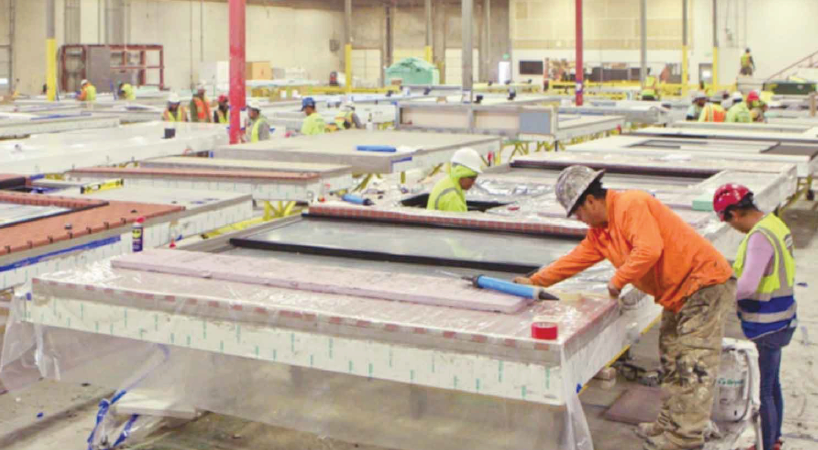
California possesses all the necessary pieces to assemble this blueprint. We have the federal capital via HUD, the targeted pre-development frameworks through the SGC, the business incentives within GO-Biz, and the advanced manufacturing capacity within our state borders. What we lack is the integrated systems-thinking to stitch these sectors into a unified strategy.
An objective analysis of these converging state and federal frameworks points to a clear structural opportunity. By establishing an ‘indigenous resilient technology pipeline,’ California has the opportunity to pioneer a structural model for resolving a chronic housing deficit without creating a cycle of perpetual dependency on temporary public subsidies and external corporate developers. Instead, by aligning localized advanced manufacturing with tribal governance and the unique demographics of urban Indigenous diasporas, the state can foster communities that are architecturally resilient, economically self-determined, and structurally secure for the hundreds of thousands of Native American and Indigenous residents across the state.
Julian Do is Co-Director of American Community Media who has a unique background in private equity and semiconductor manufacturing applied to public infrastructure analysis. He tracks the intersections of modular construction, alternative project finance, and climate-resilient technologies across California and international emerging markets. He serves on the boards of the California Civic Media Program, the California Local News Fellowship at the UC Berkeley Graduate School of Journalism, and the California News Publishers Association.


