
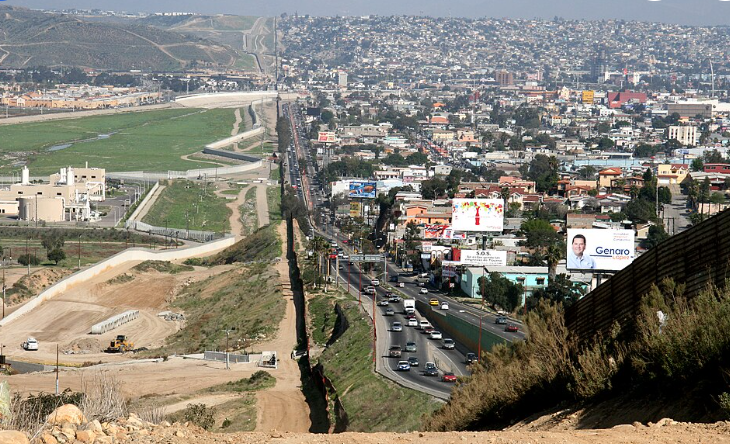
Photo: Kumeyaay Land divided by US-Mexico border, with San Diego County (left) and Tijuana, Baja California (right) by Sgt First Class Gordon Hyde, Wikimedia
Whistleblowing can be in plain sight.
Nowhere is this phenomenon more evident than along the concrete line of the U.S.–Mexico border, where the relentless toxic pollution of the Tijuana River—which has been designated one of the most endangered rivers in the country—is choking out the ancestral lands of the Kumeyaay people.
When we think of a whistleblower, often it’s a picture of an insider operating in the shadows—someone downloading classified files into a flash drive or smuggling corporate documents out of a secured facility to expose a hidden truth. But some of the most profound injustices do not require a leaked document to be proven. They exist out in the open, flowing down rivers and filling the air, systematically ignored by the institutions built to protect the public.
For decades, federal authorities on both sides of the border have looked directly at this ecological disaster, offering bureaucratic delays instead of solutions. But an artificial political line cannot sever an ancient bond.
Today, the Kumeyaay bands of San Diego and the broader Native American and Indigenous community activists are raising their voices. They are using both traditional reporting and modern social media platforms to blow the whistle on a crisis of environmental racism that has targeted their southern relatives for generations.
Long before the modern cities of San Diego and Tijuana were conceived, The Kumeyaay Nation occupied a vast, contiguous territory. Their homeland stretched from the coastal waters of the Pacific Ocean eastward across the mountains to the Imperial Valley, and from the sands of Oceanside down past the Todos Santos Bay in Baja California. They were one people, unified by language, culture, family, and a deep spiritual stewardship of the land.
That geographic unity was shattered in 1848 with the signing of the Treaty of Guadalupe Hidalgo. Following the Mexican-American War, international boundary commission surveyors drew a straight line through the heart of the Kumeyaay nation. With the stroke of a pen, and without an ounce of tribal consultation, a sovereign indigenous population was sliced in two—placing the northern bands under United States jurisdiction and the southern bands under the flag of Mexico.
In the nearly two centuries since, both sides of the Kumeyaay nation have endured parallel paths of institutional racism, land encroachment, and systemic neglect. In the United States, the northern bands fought through centuries of forced assimilation and displacement onto reservations. In Mexico, the southern communities—including Juntas de Nejí, San José de la Zorra, San Antonio Necua, and La Huerta—were forced into marginalized agrarian legal structures, frequently denied basic infrastructure, clean drinking water, and political visibility by distant federal entities in Mexico City.
Yet, despite a wall that grew higher and a border that grew increasingly militarized and rigid over the decades, the cultural and familial bond between the northern and southern Kumeyaay has never been broken. They remain one people.
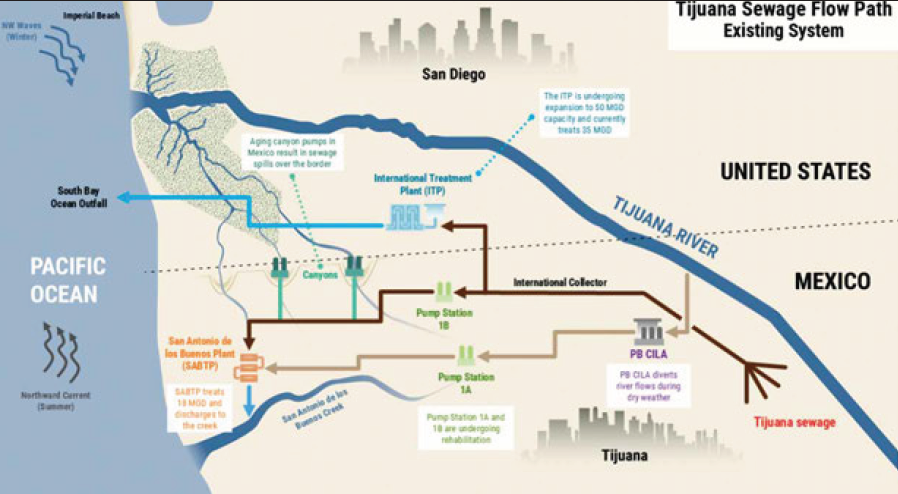
Currently, the most urgent threat to this unbroken nation is an environmental catastrophe that flows directly across the border. The Tijuana River watershed has become an open conduit for raw sewage, industrial chemical runoff, and heavy metal contamination, driven by rapid, under-regulated urban development and failing wastewater infrastructure in Baja California.
For the Kumeyaay communities residing in the path of this watershed and along the cross-border coastal valleys, the pollution is not just an eyesore; it is an existential crisis. It poisons the local flora used for traditional medicine, contaminates the water tables vital for agriculture and livestock, and introduces severe public health hazards to a population already isolated from robust healthcare systems.
The true corruption here is not that the infrastructure failed—it is that the failure has been institutionalized. When government authorities review empirical data, acknowledge the presence of toxic pathogens, and yet respond with empty promises and multi-year delays, the silence becomes a deliberate cover-up. Because the immediate, harshest consequences are borne by a marginalized indigenous population, the crisis is allowed to fester. It is environmental racism masquerading as bureaucratic inertia.
In Mexico, speaking out directly against federal water authorities or powerful industrial actors in Baja California carries immense political and economic risk for marginalized communities.
Time and again, when courageous Kumeyaay leaders in Baja California risk their safety to post raw video evidence of environmental degradation on social media, it is immediately picked up, verified, and amplified across the border. Through independent indigenous media networks—anchored by the community reporting of Indian Voices and mobilized digitally by the Indigenous Network—native storytellers are turning our regional media infrastructure into a shield and a loudspeaker for their southern relatives. This dynamic demonstrates that trans-border sovereignty is a living reality and a form of unified self-defense.
They are standing up for themselves and reminding the world that while a line on a map can divide land, it cannot diminish a people’s duty to protect their ancestral waters, heritage, and each other. The whistle has been blown, the evidence is in plain sight, and the environmental justice demand for solving the Tijuana River toxic pollution can no longer be ignored.


