
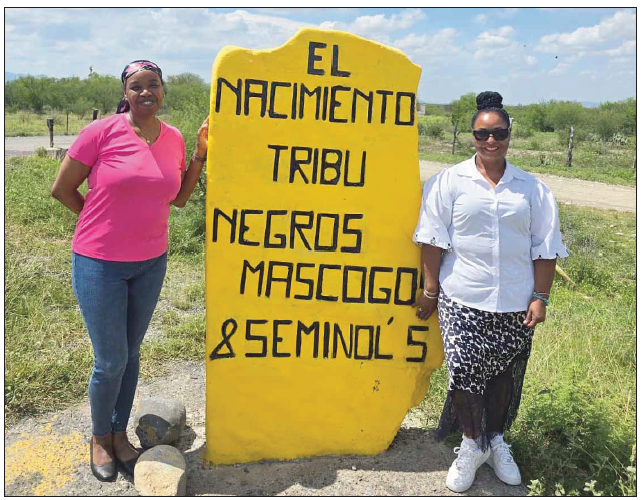
Photo: The Author, left, and a relative from the Bracketville Seminole community visiting the Seminole community in Mexico, El Nacimento de los Negros
On Saturday, July 11, I walked across the border in Eagle Pass, Texas, and into Piedras Negras, Coahuila, Mexico. After walking across the border, I got into a taxi that took me to a bus station. From there, I got onto a bus that took me to Nueva Rosita. Then, I got on another bus that took me to Muzquiz, where I was met by my dear friends and primas Corina and Isabel. We had all come to Mexico to celebrate the arrival of the Black Seminoles in El Nacimiento de los Negros.
On July 12, 1850, which was 176 years ago, the Black Seminoles officially settled in Mexico. They were granted land and citizenship by the Mexican authorities. This land and citizenship were given to the Black Seminoles/Negros Mascogos because they had agreed to help Mexico defend its border. The Black Seminoles would protect the Mexican border for the next twenty years. Following the conclusion of their service, they remained in this town.
The reason this town, this place they could finally call their own, is so important is because the Black Seminoles had been forced to move several times in their search for a permanent home. As early as the 1680s, there were accounts of enslaved Africans absconding from slavery in the Lowcountry region of the United States and finding refuge in Spanish Florida. These formerly enslaved Africans, now called “maroons,” would come in contact with another group known as the Seminoles, and while the two groups tried to forge lives for themselves, they were seen as a threat by white slave owners and the United States, which wanted Florida. Over the course of several more decades and after fighting three wars, known as the Seminole Wars, the maroons, who were now known as the Black Seminoles, agreed to relocate to Indian Territory, bringing an end to the Second Seminole War (1835-1842). They, like several other Native Americans from the Southeast, trekked the Trail of Tears. They were boated up the Mississippi and Arkansas Rivers. When they arrived in what is now present-day Oklahoma, they realized that the promises of freedom that had been made in Florida would not be kept. After staying in Oklahoma for less than a decade, a group of Seminoles and Black Seminoles led by Wild Cat and John Horse, respectively, went on a 700-mile, nearly year long journey that would terminate only after they crossed the Mexican border. Crossing that border meant safety and freedom.
Corina began celebrating this special date two years ago. This year’s celebration included a tribute to Professor Enrique Hernández Vásquez, who has done invaluable research on the Álvarez family, who found refuge in the Lagunera region. Members of this family were invited to visit and speak about how some of the Black Seminoles had moved there. There was also a presentation about the Black Seminole diaspora. I spoke about the revitalization of Afro-Seminole Creole.
This was my first time visiting El Nacimiento. While I’d grown up visiting Ciudad Acuña, which is right across the Del Rio border, visiting the land that had welcomed my ancestors wasn’t always a priority. Visiting now, as an adult, meant that I was fully grateful and aware during the entire experience. My entire being took in everything intensely from the time of my arrival and well after my departure.
Nacimiento can seem like a dream. The buildings are painted in bright and inviting colors. Everyone greeted me with a hug and a smile. The food, which was all homemade, was delicious and made with love. It is a town steeped in the history of a proud and resilient people. I hate that it took me so long to visit. Now I can’t wait to go back.


