

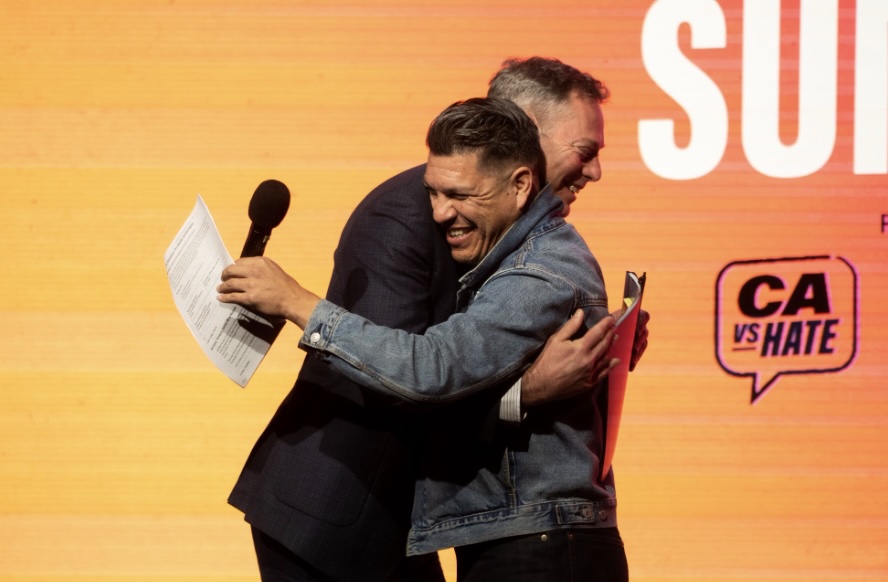
Photo credit: Devyn Session
Indigenous Network brings a special report from the first California Civil Rights Summit, where hundreds of community members, advocates, artists, educators and public officials gathered for a full day of connection and conversation.
During the May 11 event — held by the California Commission on the State of Hate, CA vs Hate and Stop the Hate at San Francisco’s Commonwealth Club — the room was full of anticipation.
People had traveled from across California, representing community organizations, schools, government agencies, cultural institutions and advocacy groups. While the topics were serious, the atmosphere was not one of defeat. San Francisco City Attorney David Chiu opened by asking attendees to look around the room.
"We are artists, advocates, civil rights lawyers, teachers," Chiu said. "We're from the private sector, we're from the nonprofit sector. We are from San Diego, the Inland Empire, Chico and San Francisco. And together, we are going to get this done."
The California Civil Rights Department organized the summit as reports of hate continue across the state: According to survey data shared during the event, over three million Californians directly experienced at least one hate act in one year.
One of the strongest conversations of the day came during a panel moderated by Dr. Gloria Duffy, president and CEO of the Commonwealth Club of World Affairs.
Former Assemblymember Phil Ting opened the panel with a strong statement. "We really are at a crossroads," Ting said. "We are at the first time in American history where we are seeing an erosion of civil rights."
"It's a call for this generation to fight for our rights,” he continued. “I think we need to take a hard look at what we can do differently."
Duffy asked California Civil Rights Department Director Kevin Kish about how the state can respond. He framed the moment within California history, reminding attendees that some of the darkest chapters in the state's past were government-sanctioned.
"I want people to know, this is not the only time that it has been dark," Kish said.
He cited three historical examples: In 1852, the California legislature passed the Fugitive Slave Act of California allowing slaveholders to recover enslaved people who had escaped into the state; in 1871, a mob of roughly 500 people in Los Angeles lynched at least 18 Chinese residents — over 10% of the city’s population at the time, while only a few perpetrators were prosecuted; and during a nationwide Mexican repatriation movement in the 1930s, an estimated 1 to 1.8 million people of Mexican descent were forcibly deported to Mexico, even though 60% of those deported were American citizens.
All of these were state-sanctioned events, Kish said, but in each era there were also people who stood against this hate. Now, he continued, concrete services are needed that people can access — which is why CA vs Hate, the department's hate incident and hate crime reporting hotline, was created.
The conversation shifted throughout the day between policy, personal experience and culture.
After a break, the program returned with some joy: a conversation between San Francisco Drag Laureate Per Sia and 2025 NPR Tiny Desk Contest-winning rapper Ruby Ibarra, moderated by Michelle Meow, a board member of SF Pride and the Commonwealth Club of World Affairs.
Ibarra spoke openly about impostor syndrome and the effects of growing up without seeing people who looked like her represented in the media, while Meow reflected on how powerful representation can be, especially for children trying to understand where they belong.
And it is powerful to belong, to be together, said the next speaker, Tomiquia Moss — Secretary of California's Business, Consumer Services and Housing Agency — arguing that it is among Californians’ greatest strengths.
She added that in 2025, the California Civil Rights Department received nearly 1,000 reports of hate incidents and more than 6,800 requests for help.
Moss underscored the power of collective action and closed with a rallying cry: "Keep fighting, y'all!"
Film was also part of the program. After a screening of Daren Dien’s short film “Birth of a Mind” — about three respectively white, Black and Filipino children who game together online in easy friendship until each set of parents intervenes, instructing their child to stick to their own — Dien joined a discussion about survival, trauma, and healing.
An audience member referenced the phrase “Trauma not transformed is transferred," leading to a conversation about the ways people carry experiences forward and what it takes to interrupt those cycles.
Next came a panel moderated by Yosi Sergant, founder and partner at TaskForce. He opened with a question that would shape the discussion: What is culture, and how do we define it?
One of the strongest responses came from Favianna Rodriguez, founder of the Center for Cultural Power. She argued that culture is often left out of conversations about social change, despite its enormous influence.
"We want to change culture because cultural change precedes political change, and policy is a manifestation of an idea whose time has come," Rodriguez said, explaining that her organization's goal is to make culture the most fertile ground possible for good policy to take root.
"Culture shapes both the political sector and the economic sector, and it's one of the most underinvested and untapped tools we have within our social change sector," she added.
Edreece Arghandiwal of Oakland Roots and Oakland Soul offered a different example. He pointed to the reach of soccer, noting that more people follow the sport worldwide than all religions combined.
Because of that reach, he said, Oakland Roots has been intentional about creating a space that can bring people together across different backgrounds and beliefs. The club is conscious of how it presents itself, Arghandiwal continued, seeing sports as a way to connect communities that might not otherwise find common ground.
Marlon Richardson, executive director of Hip Hop For Change, spoke about his organization's work in anti-racist education and trauma-informed teaching. He reflected on the origins of hip-hop, which began more than 50 years ago when young people in the Bronx started throwing intercultural get-togethers. Today, he noted, hip-hop has become one of America's most influential cultural exports.
"People may not like America, but they like hip-hop," Richardson said. He spoke about the messages found throughout the genre, describing many hip-hop lyrics as expressions of hope and visions of a brighter future.
"Hip-hop is the dream that Martin Luther King was talking about," he added.
To close the day, civil rights activist Ericka Huggins joined Kish for a conversation that reflected on history and personal responsibility.
Huggins, who spent 14 years in the leadership of the Black Panther Party — the longest tenure of any woman in party leadership — spoke about her experiences in the civil rights movement and the lessons that continue to guide her work today.
“If you want something, and it's in your heart so strongly, you must do something," she said.
Near the end of the conversation, Kish returned to a question Huggins often posed: “What is the first step in eliciting compassion?”
It was a fitting way to conclude a day spent discussing hate, belonging and collective action.


