
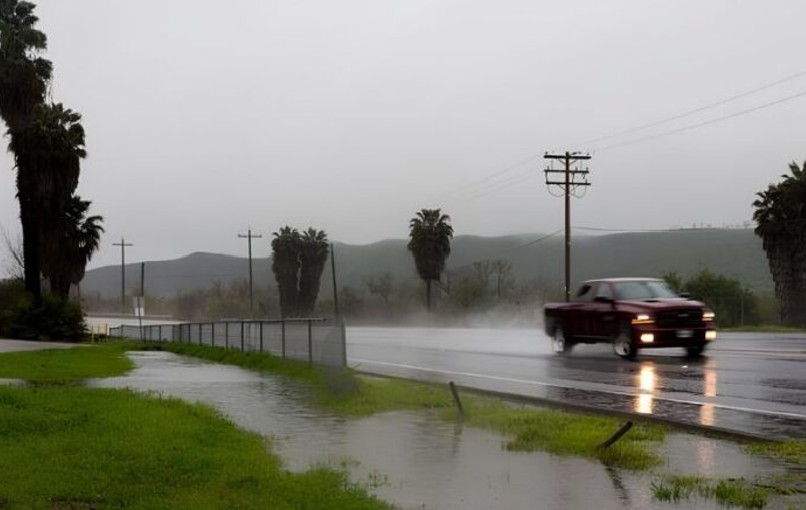
Feature image via Defense Visual Information Distribution Service
This year’s El Niño is forecast to intensify into what could be the strongest event ever observed, bringing rising seas, elevated flood risk and a wet winter to California in the months ahead.
Ocean temperatures in the eastern tropical Pacific — a core driver of El Niño — are already the highest ever recorded for this time of year, with a record-setting rate of warming in the region since spring. Virtually all current forecasts show this “super El Niño” event strengthening beyond the strongest previously observed, said Dr. Daniel Swain, a climate scientist at UCLA, the National Center for Atmospheric Research and The Nature Conservancy, at an American Community Media briefing.
What happens in an El Niño?
While there is no formal scientific definition of a super El Niño, Swain suggested “maybe we need a new category of extreme El Niño, because the forecast for this year is genuinely extreme.”
El Niño forms when weakened trade winds allow warm water from the western Pacific to slosh eastward, warming the ocean off Peru and Ecuador. The event affects global climate in two main ways, said Swain.
First, it temporarily raises the planet’s average temperature — a natural, temporary, “mini-global warming” on top of the “permanent, human-caused” kind — which is why global temperatures are expected to reach new records over the next six to 12 months, alongside an overall rise in extreme heat, rainfall and drought risk.
Second, on top of that overall increase in heat and moisture, El Niño “shifts storm tracks toward specific regions,” he continued, so some places, including California, bear a disproportionate share of those risks.
The event is expected to peak between October and December, likely November. But for California and other regions outside the tropics, Swain said the “peak impacts” are likely to come in December and last through March, or later.
California’s winter could be unusually dangerous
The clearest signal in California will be a wetter-than-average winter, particularly in the central and southern parts of the state, raising the risk of inland flooding from the Sierra Nevada to the Southern California coastal plain.
Some impacts are already underway: Ocean waters off the central and southern coast are warmer than average, disrupting marine ecosystems and drawing subtropical fish species farther north while compounding heat-related illness risk during a humid late summer and fall.
Coastal sea levels are also temporarily rising, Swain explained, and by November and December will coincide with the winter’s largest storm waves and “astronomically high” king tides unrelated to El Niño.
Low-lying communities roughly five or six feet above sea level around the San Francisco Bay, Monterey Bay, Carquinez Strait and the Sacramento-San Joaquin Delta including Stockton also face elevated flood risk as a result, along with coastal erosion severe enough to threaten roads and rail lines.
Swain said “erosion, which will get worse,” has already forced closures of parts of the Pacific Coast Highway near Malibu, and the Amtrak line connecting Los Angeles and San Diego.
“El Niño doesn’t guarantee a wet winter in California,” he continued, “but a very strong, potentially historically strong event, which is our expectation for this year, likely increases the amount of precipitation that California will experience this winter.”
But a warmer atmosphere means more of that precipitation could fall as rain rather than snow at lower elevations.
“We could have a wet, warm winter” with heavy snow only above 8,000 or 9,000 feet, while leaving lower-elevation areas like Lake Tahoe with less snowpack than rain totals might suggest, said Swain.
Asked whether the coming El Niño should be treated as a strategic threat to Los Angeles following political criticism of the city’s response to last year’s wildfires, Swain said Southern California will likely see some of the state’s strongest impacts.
Local agencies have already begun building sand berms along beaches to guard against rising sea activity, and Swain himself has fielded a surge of briefing requests from regional water agencies since publishing an El Niño fact sheet this week.
While “this is not an imminent disaster,” with most impacts remaining months away, Swain said cities should still “communicate plans” about flood risk beyond the debris-flow zones, including the potential for urban flooding in rarer, inland areas like South Los Angeles.
Drought and flooding beyond California
Similar water uncertainties apply to the Southwest.
The Colorado River lower basin, including Arizona, will likely see at least an average and probably above-average winter, offering temporary relief from a prolonged drought and federal cuts to the river’s high-demand allotments.
But “even perhaps the wettest year on record would not solve the problem” of the basin’s water crisis, said Swain, citing outstripped water supplies and ongoing climate change. “The long term trend is one of massive aridification … even if next summer is maybe somewhat less challenging.”
The Pacific Northwest, including Washington state and southern British Columbia, could see existing drought and wildfire conditions worsen, while the southeastern United States, including the Carolinas, Georgia and Florida, will likely have an unusually wet winter easing ongoing local droughts.
Hawaii is expected to see below-average precipitation and worsening drought, despite recent hurricane rain and storms.
Health risks could outlast the winter
Drought and floods both raise the risk of waterborne illness, particularly in rural and tribal areas in the Southwest with “little or tenuous water treatment infrastructure,” said Swain.
He pointed to valley fever, a fungal infection that spreads as wet soil dries — particularly in the Southwest — as a likely concern the summer and fall after this winter, particularly for farmworkers and incarcerated people with limited access to filtered air.
Over the past 20 years, 99% of U.S. counties have experienced a flood event.
With one in every 10 U.S. residents living in a low-elevation coastal zone — and only about 2% of California homeowners holding flood insurance — Swain urged residents to consider coverage this year.
He added a warning about how misinformation spreads regarding the need to prepare. Exaggerated risk claims surface online, he said, “then some journalists pick it up, the headlines are a little bit hyperbolic,” then scientists “feel the need to play the reasonable mediator to the point where the very real risks sometimes end up being underemphasized. The irony is the exaggeration leads to underemphasis of the importance of what’s going on.”
“We really are headed for a very strong El Niño event, maybe even most likely the strongest on record, and that genuinely is a big deal,” Swain said, but, “We actually have a fairly long runway in front of us before most of the negative impacts might materialize, so that gives us some real time to do something about it.”
Feature image via Defense Visual Information Distribution Service


