
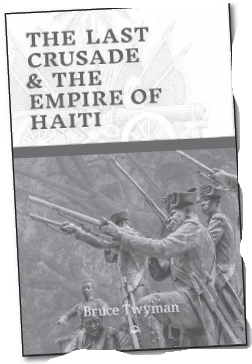
Bruce E. Twyman, the author of The
Black Seminole Legacy, and North
American Politics, 1693 to 1845, has a
new title release. The new book is, The
Last Crusade and the Empire of Haiti. This
book was inspired by Twyman’s Black
Seminole Legacy research. A key nexus
between the Haitian Revolution and the
Black Seminole Wars, was
the Haitian Maroon General
George Biassou. Biassou
exited Haiti in 1795 and
arrived in Florida with a
small auxiliary force as allies
of the Spanish colonial
government. Though
Biassou would die in 1801,
members of his band
married into the broader
Black Seminole community,
and participated in the
Patriots War of 1812. Even a
superficial examination of
Biassou leads directly to his subordinate
officer in the beginning of the Revolution,
Toussaint L’Overture.
The Last Crusade and the Empire of
Haiti, highlights the Roman Catholic
struggle against the Islamic rise and
expansion into, Europe and territory
formerly held by the Roman Empire. The
official Church struggle initiated against
Islam was the Crusades. A major location
of the Crusades was on the Iberian
Peninsula. This was the site of Spain and
Portugal – previously known as Roman
Hispania. The Islamic Moors conquered
and held the Iberian Peninsula for 700
years. The Crusades on the Iberian
Peninsula was known as the Reconquista.
After victory over the Moors in
1492, the Christian Soldiers of the
Reconquista became
Conquistadors in the New World
Of America.
The Spanish established
colonial Hispaniola as their first
colonial base in the early
Sixteenth Century. By 1700
Hispaniola was divided
geopolitically into Spanish Santo
Domingo and French San
Domingue. The San Dominigue
Revolution ( popularly known
as the Haitian Revolution )
between 1789 and 1804,
established the Haitian Empire under
Emperor Jean Jacques Dessalines. Haitian
President Petion would give Gen. Simon
Bolivar military and political support,
while converting him to the idea of ending
slavery as a key part of the Revolution
against Spain.
These are some of the Key concepts.


